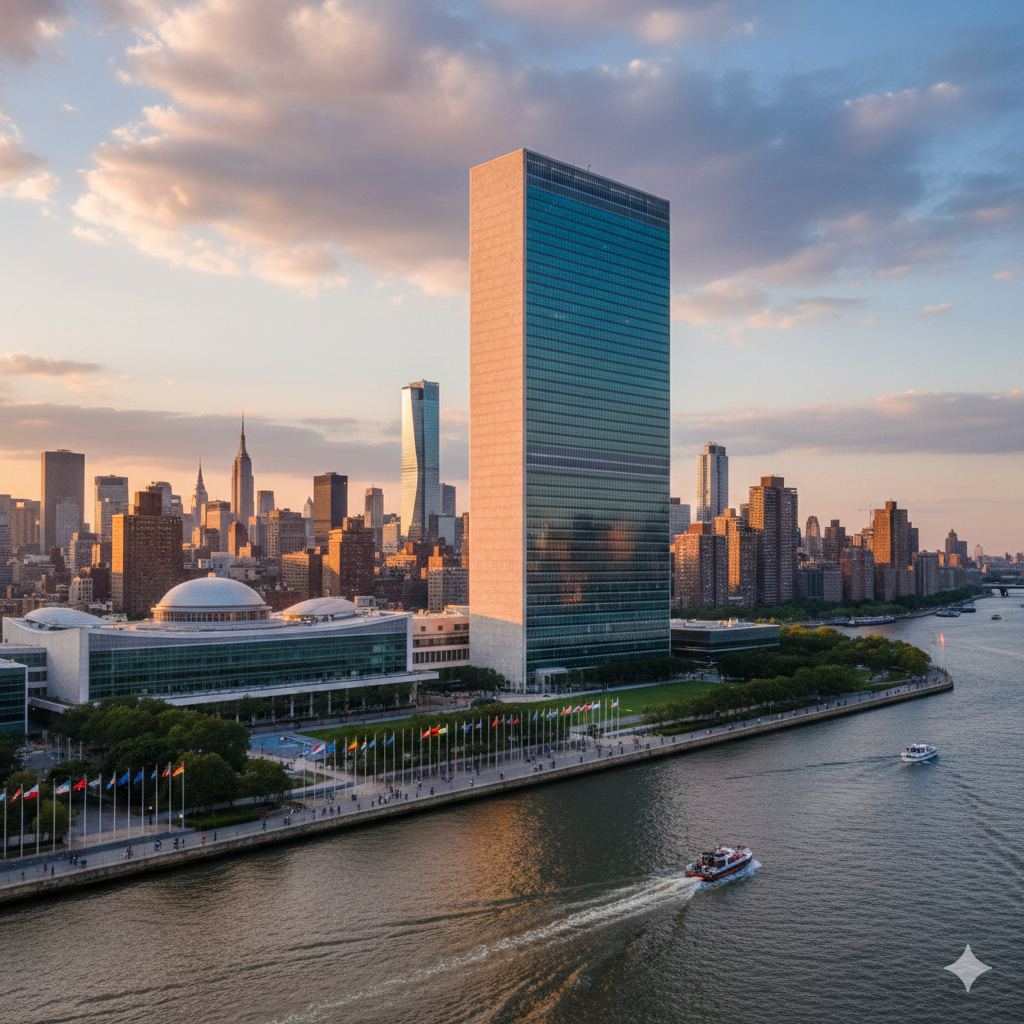
🇸🇪 A Moral Imperative: Restructuring the UN Security Council for the 21st Century
The United Nations Security Council (UNSC), charged with the primary responsibility for the maintenance of international peace and security, stands today as an anachronistic relic of a world order that has long since passed. The composition of its permanent members (P5)—the United States, China, Russia, France, and the United Kingdom—was decided not by principles of universal justice or consistent adherence to the UN Charter, but by the raw military and political power of the victors of World War II. To usher in a new era of global governance that truly lives up to the lofty ideals of its founding document, the P5 must voluntarily step down, and a new, more principled standard for membership, one centered on constitutional governance, human rights, and social democracy, must be established.
The Unfitness of the Current P5
The privileged position of the P5 is fundamentally antithetical to the UN Charter’s core principle of the sovereign equality of all its Members. The P5 nations, each possessing the unilateral power of the veto, have repeatedly demonstrated a willingness to prioritize narrow national interests and historical power preservation over the Charter’s mandates for peace, justice, and self-determination.
A History of Charter Violations: The histories of the P5 are replete with actions that contravene the Charter’s spirit and letter. This includes, but is not limited to, unauthorized military interventions, the initiation of wars without Security Council approval, and the systematic use of the veto to shield allies or themselves from scrutiny and accountability for human rights abuses or acts of aggression. For instance, the ongoing conflict in Ukraine involves a direct military invasion by a P5 member (Russia), while other P5 members have engaged in operations like the 2003 Iraq War (US/UK) or the 2011 Libya intervention (US/UK/France) with deeply contested legal bases. This body is demonstrably incapable of holding its most powerful members accountable, rendering it functionally paralyzed on the most critical issues of international security.
The Veto as a Weapon Against Peace: The veto power is the clearest symbol of this failure. It allows a single nation to nullify the collective will of the international community, often halting resolutions aimed at preventing mass atrocities or providing humanitarian aid. As long as this tool remains tethered to nations whose actions routinely draw criticism for their alignment with the Charter’s principles, the Security Council will continue to be seen as a forum for geopolitical gridlock rather than a mechanism for collective security.
A New Standard: Constitutionalism, Socialism, and Accountability
A truly legitimate Security Council must be composed of nations whose domestic and foreign policies not only accept the obligations of the Charter but consistently embody them. This requires moving beyond military and economic might to a focus on moral authority and demonstrable good governance.
The principle should be simple: Only states that actively and measurably uphold the Purposes and Principles of the Charter are eligible for a seat, and their tenure must be conditional on the continuation of that fidelity.
Incentivizing Civilization: Requiring Security Council members to demonstrate robust democratic institutions, constitutional adherence, strong protection of civil and political rights, and commitment to social welfare—the foundations of the social contract and what can be termed a “constitutional and socialist” model—would serve as a powerful global incentive. Such a standard encourages states to reform their systems to become more equitable, transparent, and respectful of human life and dignity. Nations would vie for Council membership by showing verifiable progress in these areas, transforming the quest for power into a race to civilization.
The Model of the Scandinavian Countries: The countries of Scandinavia—such as Norway, Sweden, and Denmark—present an exemplary model for this new Council. Their long-standing commitment to multilateralism, human rights (including the pioneering of the Women, Peace and Security agenda), generous development aid, dedication to international law, and progressive social democracies make them the most suitable candidates. Their history of promoting conflict prevention, rather than intervention, aligns them perfectly with the Charter’s ideal of “saving succeeding generations from the scourge of war.” They embody a power derived from moral credibility and responsible global citizenship, not imperial force.
Conclusion: A Council for the Future
The time for a Security Council based on the obsolete power dynamics of the 1940s is over. For the United Nations to regain its credibility and effectiveness, the P5 must be replaced by nations whose domestic and international conduct is beyond reproach. The US, China, Russia, France, and the UK should step down, paving the way for a Council composed of states like the Scandinavian nations, whose selection is based on a quantifiable commitment to constitutional, egalitarian, and peace-loving governance.
Such a dramatic, yet necessary, reform would fundamentally change the global calculus. It would serve as a constant reminder that power on the world stage flows not just from the barrel of a gun or the size of an economy, but from moral authority, domestic justice, and unwavering adherence to the principles of the UN Charter. This new, principled standard is not just an organizational adjustment; it is the moral imperative for the survival of effective global multilateralism.
2 replies on “UN Security Council”
It would be better if this could happen. If it ever does.
Thanks for the comment…we’ll just have to wait and see what happens in the years to come.