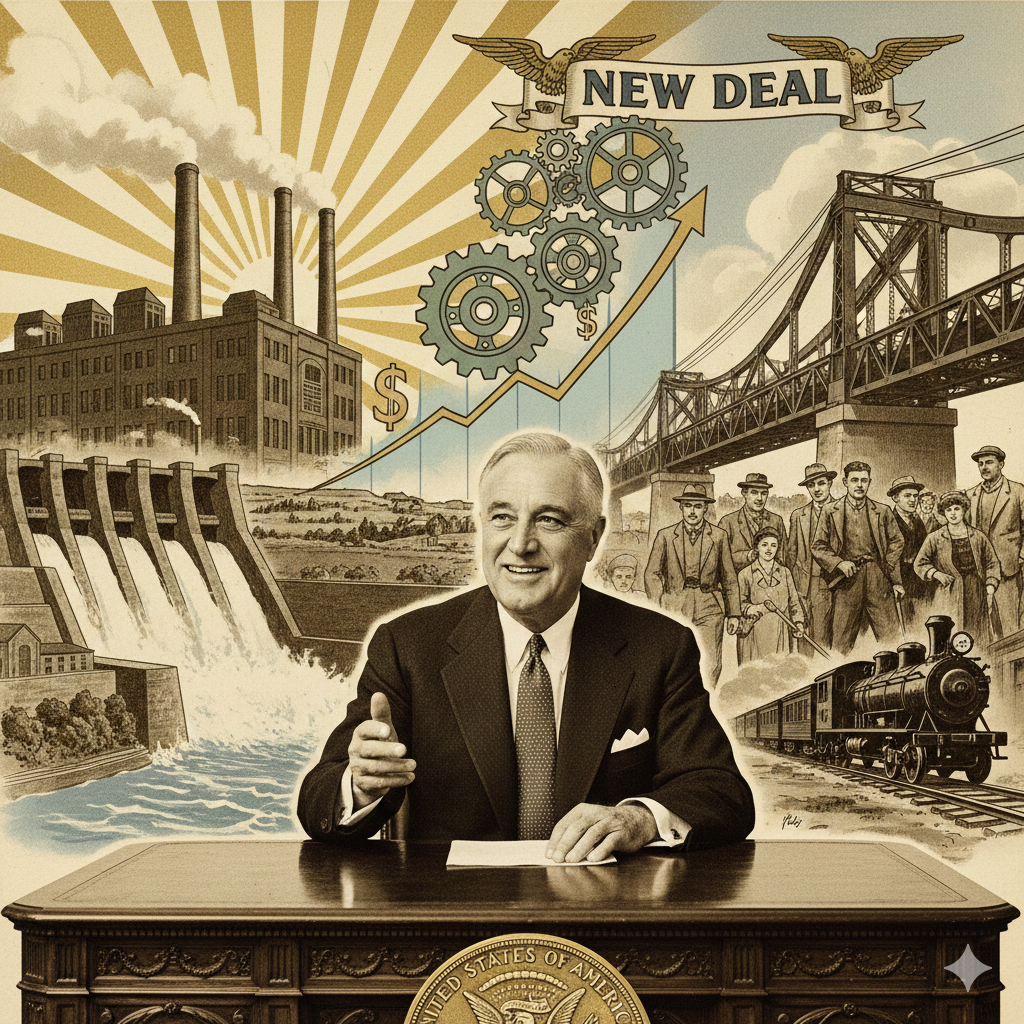
The Enduring Necessity of the New Deal: A Blueprint for Prosperity and Peace
Franklin Delano Roosevelt’s New Deal, a sweeping package of legislation enacted in the 1930s, represents more than a historical response to the Great Depression; it stands as the essential blueprint for a stable, prosperous, and socially cohesive modern society. The foundational principles of the New Deal—that the government must serve as a guarantor of economic security and a counterweight to unchecked market forces—remain profoundly relevant. Its preservation is not merely an ideological preference but a necessity for ensuring social peace and generating broad-based economic prosperity, a vision championed and protected by the Democratic Party, which has historically carried its legacy forward.
At its heart, the New Deal is a perfect practical demonstration of Keynesian economics. The British economist John Maynard Keynes argued that during a massive economic downturn, private demand falls into a trap: without jobs, people can’t spend, and because people aren’t spending, businesses won’t hire. To break this vicious cycle, Keynes argued that the government must become the “spender of last resort.” Roosevelt’s administration implemented this theory through massive public investment programs. The Works Progress Administration (WPA) and the Civilian Conservation Corps (CCC) hired millions of unemployed workers for public infrastructure projects, injecting money directly into communities. This government spending created jobs, restored consumer confidence, and boosted demand, proving that proactive fiscal policy can successfully stabilize a crisis and lay the groundwork for future growth. The modern necessity of this approach is clear: in the face of recessions, pandemics, or environmental crises, only robust, coordinated federal action can stabilize the economy and avert catastrophe.
Beyond mere recovery, the New Deal fundamentally established the architecture of American social peace. Programs like Social Security, which provides guaranteed income for the elderly, and the Federal Deposit Insurance Corporation (FDIC), which insures bank deposits, removed the existential fear that had defined American life during the Depression. Before the New Deal, losing one’s life savings to a bank failure or facing old age in poverty were common threats that fostered mass instability and political extremism. By providing a basic social safety net, the New Deal diffused class conflict and restored faith in the democratic capitalist system. It cemented the idea that economic freedom cannot exist without a measure of economic security, a principle Roosevelt articulated as freedom from want. This stability is the bedrock of societal peace, allowing citizens to focus on contribution and community rather than survival.
The enduring relevance of the New Deal is most visible in its continuing institutions, which safeguard economic prosperity for all Americans. The creation of the Securities and Exchange Commission (SEC) regulates financial markets, preventing the kind of reckless speculation that triggered the 1929 crash. The National Labor Relations Act (NLRA) protected the right to organize unions, shifting power back to the worker and helping to build the robust middle class that defined the mid-20th century. The Tennessee Valley Authority (TVA) developed vital infrastructure and brought electricity to rural areas, demonstrating that public investment can unlock immense economic potential and ensure equitable access to modern life. Preserving these regulations and institutions—from market oversight to worker protections—is essential to prevent a return to the unchecked corporate power and extreme inequality that characterized the Gilded Age and the 1920s.
The mandate to preserve the New Deal’s legacy is intrinsically tied to the platform of the Democratic Party. Since the 1930s, the Democratic Party has been the primary political custodian of these policies, consistently advocating for the maintenance and expansion of the social safety net, worker protections, and government regulation of the financial sector. Voting Democratic is therefore the most direct means of ensuring the longevity of Social Security, strengthening the rights guaranteed by the NLRA, and advancing the use of Keynesian-inspired public investment to tackle modern challenges like climate change and infrastructure renewal. While specific programs must evolve, the underlying philosophy—that government has an active role in creating a more just and economically balanced society—is the philosophical inheritance of the Democratic Party and the ultimate necessity for a future of shared prosperity and social harmony.