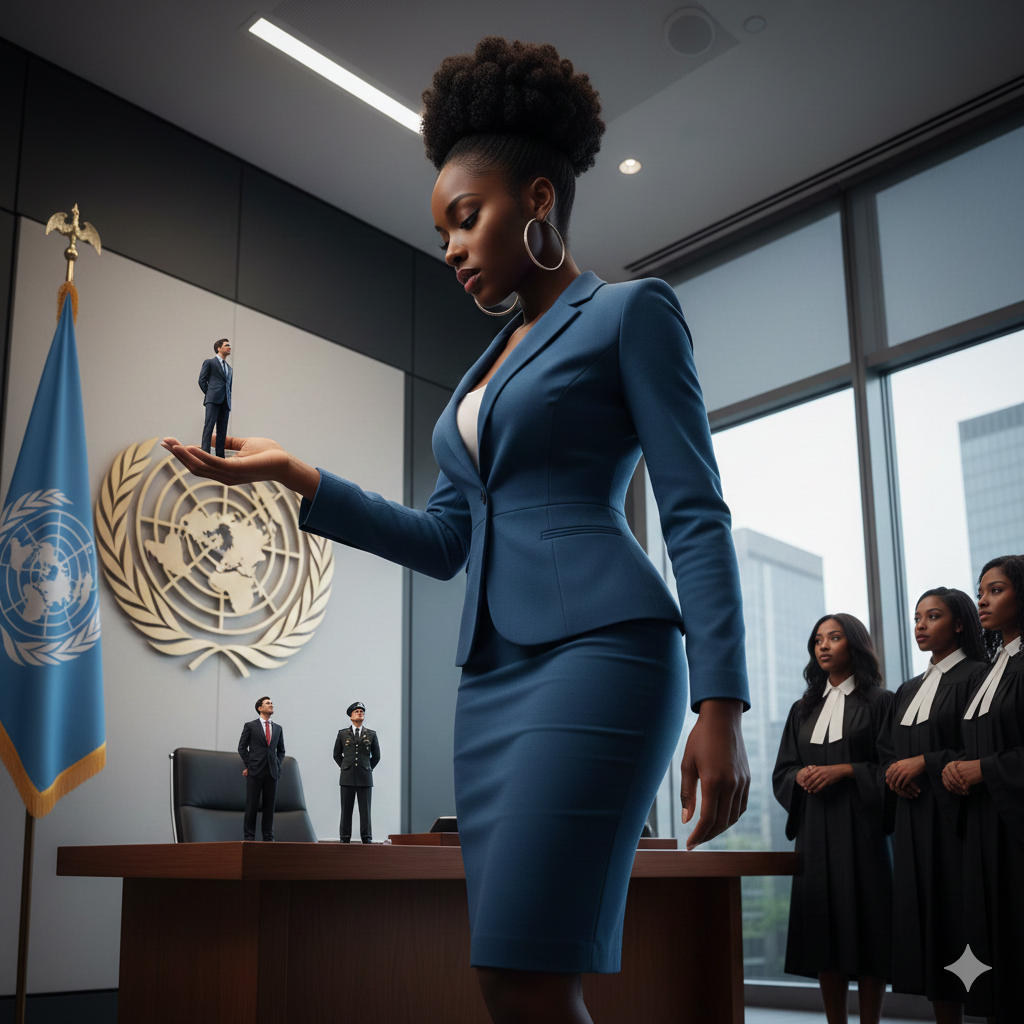
The “Giants” of Global Justice: Why the ICC and UN Need Real Teeth
Since its inception, the International Criminal Court (ICC) has been described as a “giant without arms or legs.” It has the moral authority to issue warrants for the world’s worst criminals—genocidaires, war criminals, and those who commit crimes against humanity—but it possesses no police force to arrest them. Instead, it must politely ask sovereign nations to do the heavy lifting, a request often ignored when political interests are at stake.
To truly fulfill the promise of “never again,” the international community must transform the ICC and the United Nations (UN) from advisory bodies into empowered “giants” capable of enforcing global law through direct military, economic, and fiscal power.
The Enforcement Paradox: A Court Without a Police Force
The ICC’s primary weakness is its dependence on state cooperation. Under the Rome Statute, the court relies entirely on member states to execute arrest warrants. When a head of state is indicted, the very government they lead is often the one tasked with their arrest—an obvious conflict of interest.
- The Problem of Impunity: Fugitives like Omar al-Bashir famously traveled to ICC member states for years without being arrested, exposing the court’s “lion without teeth” status.4
- The Need for an ICC Marshall Service: A stronger ICC would feature its own specialized enforcement wing. This unit would have the legal authority and physical capability to conduct arrests in any jurisdiction where a crime under the Rome Statute has occurred, bypasssing the bottleneck of local political will.
The UN as a Global Sovereign: Three Pillars of Power
For the ICC to be a “giant,” it must be backed by an even larger one: a revitalized United Nations. Currently, the UN operates on a “pass-the-hat” model, begging for troop contributions and budget payments. To stabilize the world, the UN requires three specific types of “hard power”:
1. Military Power: A Standing Global Army
The UN currently relies on “Blue Helmets”—troops borrowed from national militaries who can be withdrawn at any time. A UN Standing Army would be a permanent, independent force answerable only to the UN Secretariat and Security Council.
- Rapid Response: It could intervene in genocides in days, not months.
- Deterrence: No warlord or rogue general would dare commit atrocities if they knew a superior, neutral force was permanently stationed to uphold international law.
2. Tax Power: Financial Independence
The UN’s effectiveness is often hamstrung by member states—particularly the most powerful—threatening to withhold dues to influence policy.
- Global Levies: By implementing small “global taxes” (such as a 0.1% tax on international currency transactions or a global carbon tax), the UN would gain a reliable, independent revenue stream.
- Stability: This would allow for long-term planning in humanitarian aid and peacekeeping without the fear of political blackmail.
3. Economic Power: Centralized Sanctions
Instead of the current patchwork of national sanctions, a “Giant UN” would have the power to manage a global economic registry. It could unilaterally freeze the assets of indicted individuals and the entities that fund them, cutting off the “oxygen of war” with a single administrative stroke.
Coordinating the “Giants”
A stronger ICC and UN must work in a closed loop. The ICC would provide the legal mandate (the warrant), and the UN would provide the physical and economic means (the arrest and the asset freeze).
| Feature | Current | Proposed |
| Arrest Power | Relies on local police/military | Independent ICC Enforcement Wing |
| Military | Ad-hoc peacekeeping | Permanent UN Standing Army |
| Funding | Voluntary member dues | Direct global taxation |
| Enforcement | Diplomatic pressure | Hard economic & military intervention |
Conclusion: From Aspiration to Action
The current international system is built on the myth of absolute state sovereignty—a myth that allows dictators to hide behind borders while committing atrocities. To protect the most vulnerable, we must move toward a model where the ICC and UN are the “giants” in the room, capable of over-matching any individual state’s ability to protect a criminal. Only when the scales of power are tipped in favor of global justice will the law become more than a mere suggestion.