The Shadows of Davos: Will the Greenland Accord Mirror Munich?
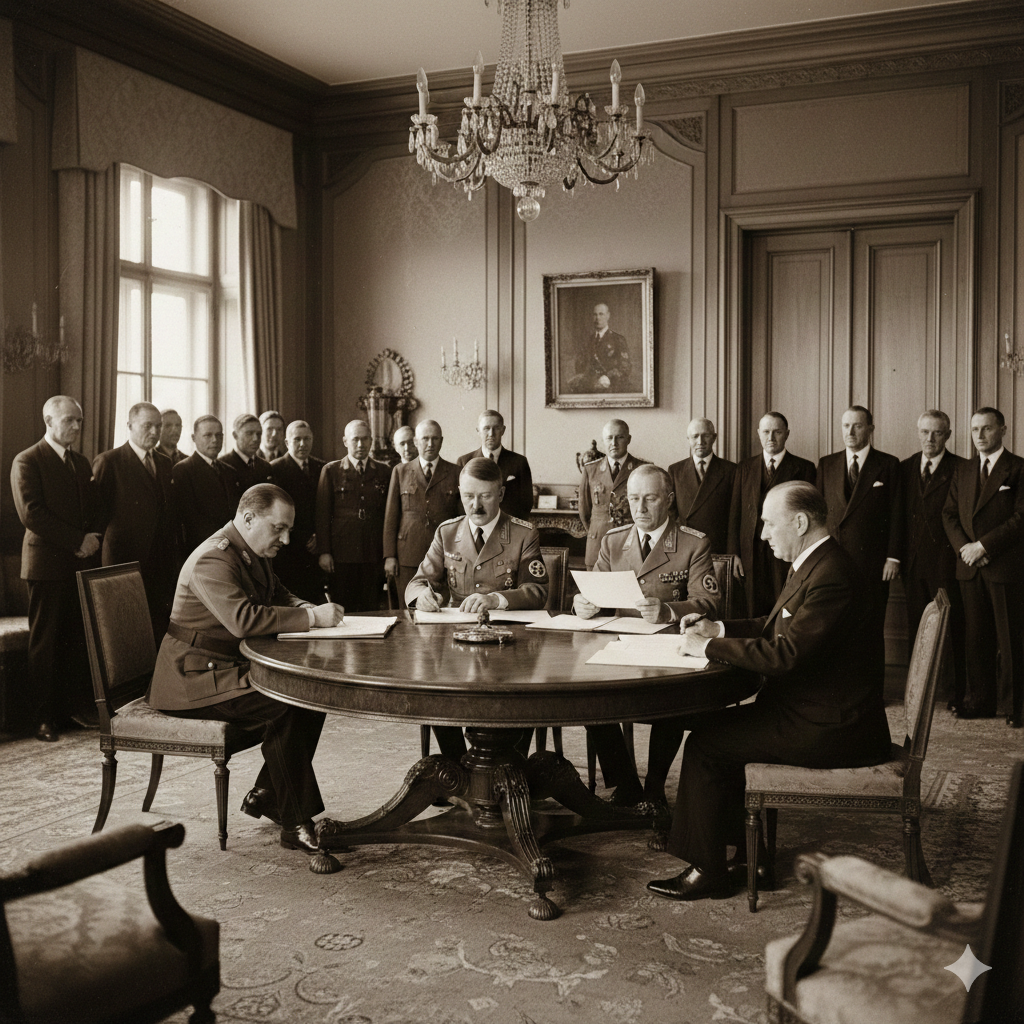
The announcement today in Davos of a “framework” agreement between President Trump and European leaders—purportedly ending the immediate threat of 10% to 25% tariffs in exchange for a “future deal” on Arctic security and Greenland—has been met with a collective sigh of relief from global markets. On the surface, the “trade bazooka” has been holstered, and the specter of a trans-Atlantic trade war has receded. However, for those with a sense of history, the atmosphere feels uncomfortably familiar. One cannot help but look at this “framework” and hear the faint, haunting echoes of the 1938 Munich Agreement.
While the geopolitical stakes of 2026 are not an exact mirror of the 1930s, the structural parallels are unsettling. Today, we must ask: Is this truly a blueprint for a stable Arctic, or is it merely “peace in our time”—a temporary reprieve that emboldens future aggression?
The Anatomy of Pressure: Sudetenland and the Arctic
In 1938, the Munich Agreement was born from a desire to avoid a catastrophic war by “adjusting” borders—specifically by ceding the Sudetenland to Nazi Germany. The rationale was that by satisfying a specific territorial demand, the larger international order could be preserved.
In 2026, we see a modern variant of this coercive diplomacy. President Trump’s campaign to acquire Greenland—framed as a national security necessity against Russia and China—was backed by the explicit threat of crippling tariffs on eight European allies. By targeting Denmark, the UK, France, and others, the administration used economic leverage to force a discussion on territorial integrity that European leaders previously called “non-negotiable.”
The “framework” reached with NATO Secretary General Mark Rutte suggests a compromise: the U.S. backs off the tariffs, and Europe enters “immediate negotiations” over the status of Greenland. But like Munich, this deal was brokered largely over the heads of those most affected. Just as the Czechoslovaks were excluded in 1938, the 57,000 residents of Greenland find their future being bartered in Swiss hotel suites, despite a 2025 poll showing 85% opposition to a U.S. takeover.
The Fragility of a “Concept”
The greatest danger of the Munich Agreement was not just the concession itself, but the false sense of security it provided. Neville Chamberlain returned to London waving a piece of paper, believing he had managed a volatile leader’s impulses. Within months, Hitler had broken the agreement and moved on the rest of Czechoslovakia.
Today’s agreement is described by the President as a “concept of a deal.” This vagueness is the primary red flag. When a deal is built on “concepts” rather than ironclad treaties, it remains subject to the shifting whims of the signatories. If the “immediate negotiations” for Greenland’s “right, title, and ownership” do not progress at a speed the White House deems acceptable, what is to stop the 25% tariff threat from returning in June?
The history of the last year—from the appointment of a “Special Envoy to Greenland” to the dismissal of military commanders who resisted annexation talk—suggests a policy of “one way or the other.” If this framework is merely a tactical pause to let the “trade bazooka” cool down, we are not witnessing the end of a crisis, but the beginning of a more dangerous phase of escalation.
The Risk of a “Hard Way”
The most chilling parallel to 1938 lies in the rhetoric of force. Though the President ruled out military action today in Davos, saying he “doesn’t want to use force,” the caveat remains: he noted the U.S. would be “unstoppable” if it chose to.
In the 1930s, the failure of Munich led directly to the realization that appeasement only moves the finish line of conflict. If today’s framework results in the erosion of Danish sovereignty or the forced “purchase” of an autonomous people, it undermines the very “rules-based order” that NATO was built to protect. If the deal breaks down and the U.S. pursues “the hard way,” the resulting fracture in the Western alliance could trigger a geopolitical vacuum—one that Russia and China are all too ready to fill.
Conclusion: Toward a Real Peace
We must hope that 2026 is not 1938. Unlike the 1930s, we have integrated global economies and institutional safeguards like the EU’s Anti-Coercion Instrument. However, institutions are only as strong as the commitment of the leaders who helm them.
For this agreement to avoid the ignominy of Munich, it must transition from a “concept” into a transparent, multilateral dialogue that respects the self-determination of the Greenlandic people. Peace is not made by the absence of tariffs; it is made by the presence of mutual respect for sovereignty. If today’s deal is just a temporary mask for territorial ambition, then the “huge war” the world fears—whether economic or kinetic—may only be a few “changed minds” away.