Categories
Economics Technology

United Nations Space Agency (UNSA)

The Case for a Unified UN Space Agency: Unlocking the Next Era of Exploration

The history of space exploration, from the Cold War space race to the current era of commercialization, has been characterized by national competition and fragmented efforts. While great achievements have been secured by agencies like NASA, ESA, and Roscosmos, this decentralized model is increasingly inefficient and ill-equipped to meet the challenges of humanity’s future in space. The existing United Nations Office for Outer Space Affairs (UNOOSA) performs vital work in regulation and data sharing, but it is fundamentally an administrative body, lacking executive power and independent funding. To accelerate exploration, manage shared risks, and ensure space benefits all of humanity, the United Nations must establish a dedicated, fully-empowered United Nations Space Agency (UNSA), autonomously funded through a global mechanism, such as a modest, imposed income tax.


Categories
Economics Health Care Social Issues

Universal Healthcare is a Basic and Fundamental Human Right

The Churchville Imperative: Universal Healthcare as a Moral and Economic Necessity

The closure of a healthcare clinic, while a localized tragedy, often serves as a profound indicator of systemic national failure. The loss of the primary care facility in Churchville, Virginia, is a stark example of how America’s fragmented, for-profit healthcare system, exacerbated by ideologically driven cuts to essential safety nets, fails its most vulnerable citizens. This crisis, particularly prevalent in rural America, underscores an urgent need for a comprehensive, national health insurance system funded through progressive taxation—a framework that treats healthcare as a fundamental human right rather than a market commodity.

Categories
Economics

A Tax Increase will NOT Hurt the Economy

The Stimulative Power of Fiscal Neutrality: A Keynesian View on Taxes and Spending

Conventional economic wisdom often suggests that a tax increase is always a negative force in the economy, reducing consumer disposable income and slowing down growth. However, Keynesian theory offers a sophisticated counter-argument, encapsulated in the powerful concept of the balanced budget multiplier (BBM). This principle demonstrates that when government expenditure rises by the exact same amount as taxation, the net effect is a positive, debt-free boost to the overall economy. This unique outcome is explained by the fundamental mechanics of the multiplier effect and the distinct channels through which government spending and tax collection affect aggregate demand.

Categories
Economics Technology

New Technology Must be Under Social Control to Benefit Everyone

The Socialist Imperative: Managing AI’s Impact on Labor and the Economy

The rapid ascent of Artificial Intelligence (AI) poses the most significant challenge to the structure of global labor markets since the Industrial Revolution. While AI promises unprecedented gains in productivity and economic efficiency, its current trajectory—driven by purely capitalist incentives—risks creating a society defined by extreme wealth concentration and mass technological unemployment. Given this existential threat to societal stability and equitable prosperity, it is evident that only a decisive, regulatory, and redistributive socialist approach can effectively manage the transition, ensuring that the benefits of automation are universally shared and that the fundamental human right to work is preserved.

Categories
Economics

Climate Change Action and the Economy

The Pragmatic Path: Balancing Economic Well-being and Climate Action

Climate change represents one of the most profound and existential crises of the modern era, demanding urgent global mitigation and adaptation efforts. Its long-term threats—from catastrophic weather events and sea-level rise to agricultural disruption and mass migration—are clear, making the case for aggressive action seem incontrovertible. However, a purely climate-first approach, one that grants precedence over immediate economic realities, fundamentally misaligns with the foundational well-being of the average person. While the environmental imperative is undeniable, prioritizing economic stability, job security, and energy affordability for the working class is not only a moral necessity but also a pragmatic prerequisite for achieving any sustainable, long-term environmental solution.

Categories
Economics

A New and Progressive Beginning

The Necessary Dawn: Zohran Mamdani’s Election as a Mandate for Democratic Socialism and Keynesian Policy

The election of Zohran Mamdani as Mayor of New York City represents a pivotal moment, signaling a fundamental shift in American political priorities. Far from being a mere change in municipal leadership, Mamdani’s success would constitute a potent endorsement of democratic socialism, a necessary reaffirmation of Keynesian economic principles, and a pragmatic recognition that placing material economic security at the forefront of the public agenda is the most effective path toward national renewal. His platform, centered on affordability and public goods, offers a compelling blueprint for addressing inequality not only in New York but across the nation.

Categories
Economics

Economics is the Most Important Reason Not to Vote Republican

The Greater Burden: Why Republican Economic Policy Hurts the Poor More Than Social Issues

In contemporary American politics, social issues often dominate the electoral landscape, from abortion rights and gun control to cultural debates. These issues rightly spark passionate responses and deep moral concerns. However, when evaluating the impact of a political party on the well-being of the most vulnerable citizens, a pragmatic analysis reveals that Republican economic policies often inflict greater, more pervasive, and more measurable harm than their controversial stances on social matters. For low-income and working-class Americans, the party’s dedication to supply-side economics—characterized by regressive taxation and deep cuts to the social safety net—creates material damage that far outweighs the impact of social policy disagreements.

Categories
Economics

The New Deal has to be Preserved

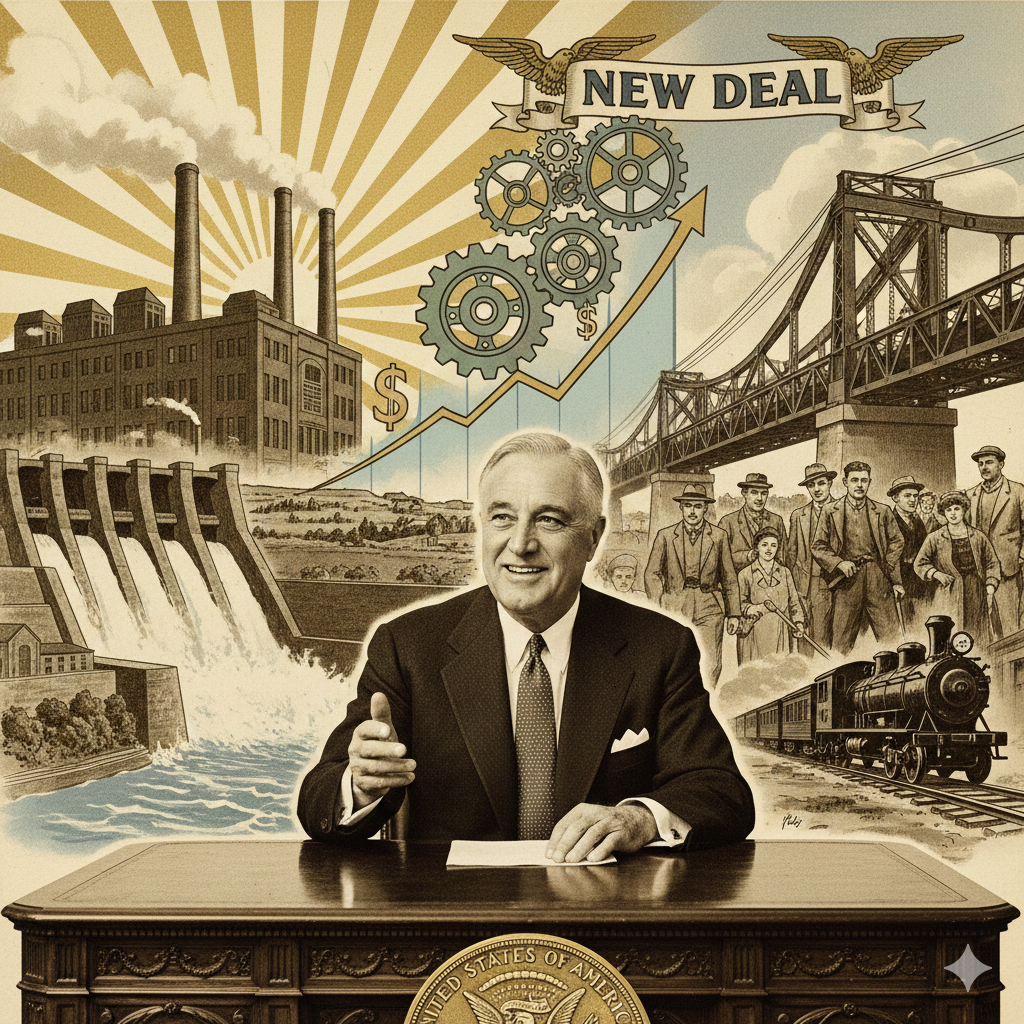
The Enduring Necessity of the New Deal: A Blueprint for Prosperity and Peace

Franklin Delano Roosevelt’s New Deal, a sweeping package of legislation enacted in the 1930s, represents more than a historical response to the Great Depression; it stands as the essential blueprint for a stable, prosperous, and socially cohesive modern society. The foundational principles of the New Deal—that the government must serve as a guarantor of economic security and a counterweight to unchecked market forces—remain profoundly relevant. Its preservation is not merely an ideological preference but a necessity for ensuring social peace and generating broad-based economic prosperity, a vision championed and protected by the Democratic Party, which has historically carried its legacy forward.

Categories
Economics

Keynesian Economics is the Most Important and Accurate Economic Model

The Indispensable Role of Keynesian Economics in Modern Stability

Keynesian economics, developed by John Maynard Keynes in response to the Great Depression, offers a fundamental challenge to classical economic theory. It asserts that aggregate demand is the primary driver of short-run economic performance and that, contrary to popular belief, markets can remain stuck in periods of high unemployment and low output indefinitely. For its emphasis on active governmental policy to stabilize the business cycle, its effective use of fiscal multipliers, and its inherent prioritization of full employment, Keynesian economics is not merely an important theory; it is the most vital and equitable framework for maintaining a resilient and flourishing modern economy.

Categories
Economics Social Issues

The Need for Democratic Socialism

The Case for Necessity: Why Democratic Socialism is Needed in America

The founding vision of the United States, as articulated in the Constitution’s preamble, is to “promote the general Welfare.” However, decades of economic deregulation and market-first policies have resulted in profound wealth disparities and systemic instability. Democratic socialism, defined not as totalitarian state control but as strong government regulation of the economy for the purpose of the general welfare, offers a necessary path to redress these failings. By prioritizing human needs over private profit in critical sectors, democratic socialism provides the regulatory tools required to build a more just, stable, and resilient society for all Americans.