Categories
Conflict Power Social Issues

Greenland and an Official UN Statement

The question of Greenland’s sovereignty has emerged as a critical flashpoint in international relations. As of early 2026, renewed pressure from the United States to acquire the territory—ranging from economic threats to the refusal to rule out military force—has created a diplomatic crisis within NATO and the United Nations.

To uphold the core principles of the UN Charter, the international community must take two decisive steps: first, a formal condemnation of any attempt by a foreign power to unilaterally annex or purchase Greenland; and second, a recommendation for Greenland’s full independence to finalize its long-standing journey toward self-determination.

Categories
Conflict Power Social Issues

UN Resolve and Action is Required in the Iranian Crisis

The Iranian Crisis: A Mandate for Multilateral Action

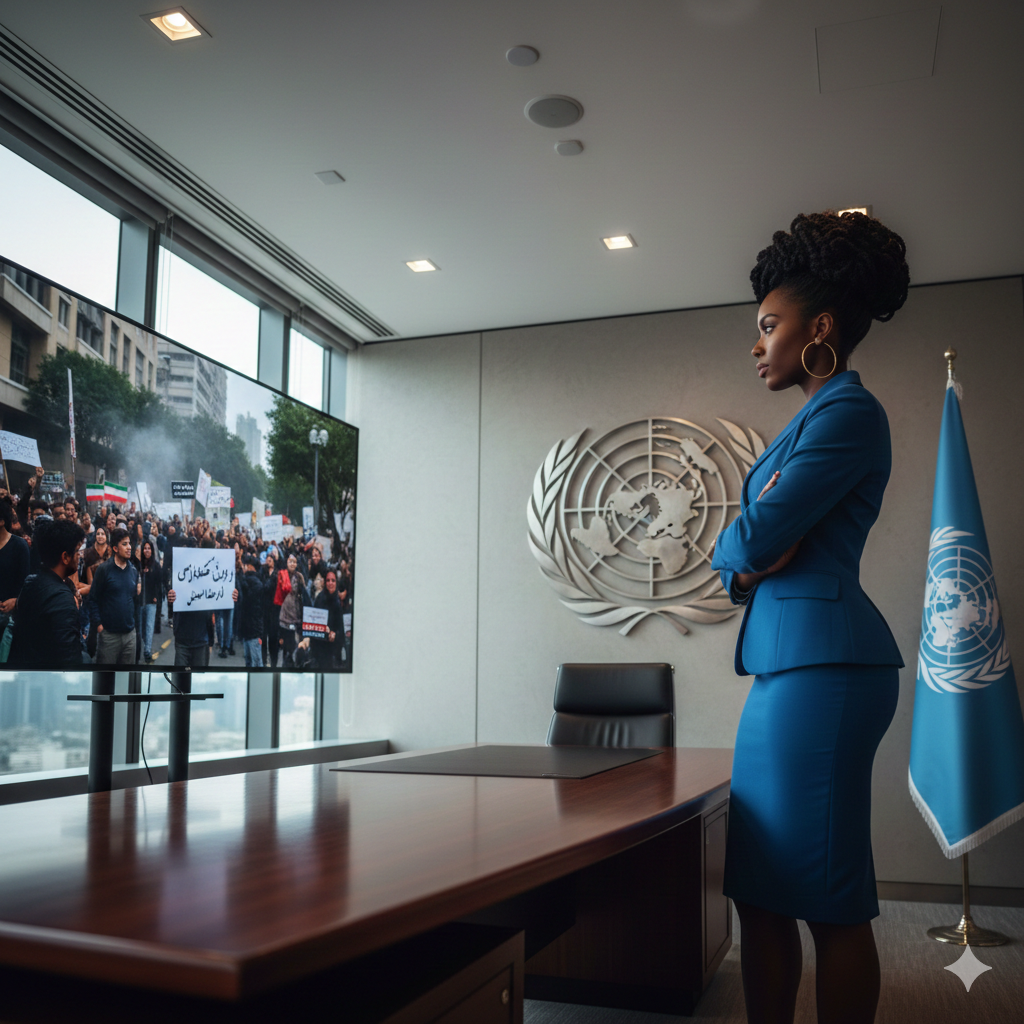
The dawn of 2026 has found Iran at a critical crossroads. Since late December 2025, a wave of civil and political unrest has swept through all 31 provinces, ignited by a collapsing economy and record inflation, but rapidly evolving into a fundamental challenge to the legitimacy of the Islamic Republic. As security forces—including the Islamic Revolutionary Guard Corps (IRGC)—deploy lethal force, the international community faces a familiar dilemma. However, the historical record suggests that the solution does not lie in the unilateral intervention of the United States. Instead, the current crisis presents a unique and necessary opportunity for the United Nations to assert its authority, enforce its Charter, and facilitate a transition from an autocratic theocracy to a productive, democratic socialist society.

Categories
Conflict Economics Power

Government Must be the Ultimate and Final Authority

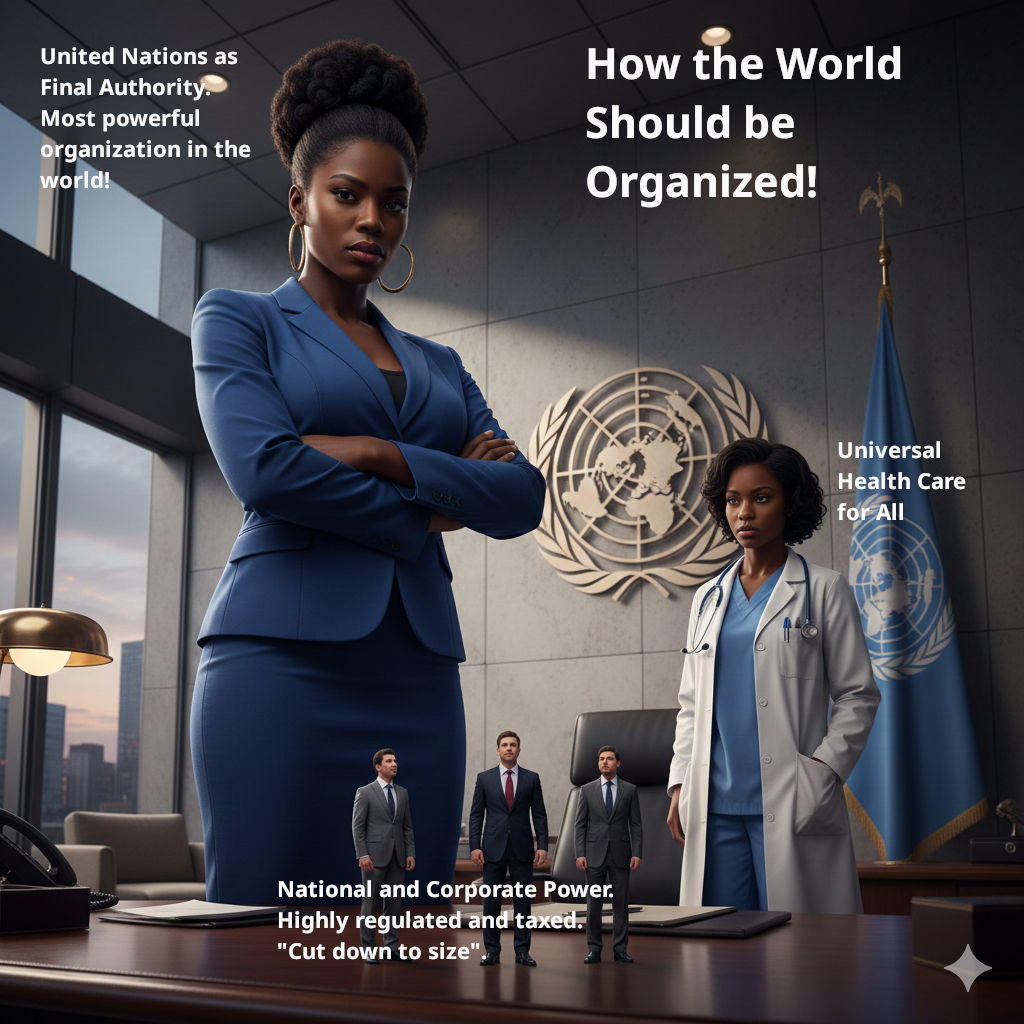
The question of how power should be distributed between the state and the private sector is one of the most enduring debates in political economy. While proponents of a free market argue for minimal interference, a strong case can be made that the collective well-being of a society depends on a government that is not merely a referee, but a dominant force. For a community to truly thrive, the government must possess the authority to redirect wealth through steep, progressive taxation and to keep corporate interests in check through rigorous regulation.

Categories
Conflict Power Social Issues

UN Authority Must be Complete and Effective

The concept of global governance often oscillates between the practical need for cooperation and the philosophical desire for a unifying authority. To envision the United Nations (UN) as the world’s most powerful organization is to imagine a shift from a collection of competing interests to a singular, cohesive direction for humanity.

In this vision, the UN does not merely serve as a forum for debate, but as the ultimate arbiter of human progress.

Categories
Conflict Power Social Issues

“Giants” Must Walk the Earth!

The Reign of the “Giants”: A Case for a Unified World Authority

The current global landscape is a fractured mosaic of competing interests, where the concept of national sovereignty often serves as a shield for conflict, environmental degradation, and systemic inequality. To move beyond this era of perpetual friction, we must evolve. The transition toward a formal world government, facilitated through a reformed and empowered United Nations, is no longer a utopian dream—it is a pragmatic necessity for survival.

However, a government without the power to enforce its laws is merely a debating society. To truly secure global peace, the United Nations must command an independent military force of such overwhelming magnitude that they are recognized, in every corner of the globe, as “Giants“.

Categories
Conflict Economics Power Social Issues

USA Seizes Russian-flagged Tanker and a Venezuelian Ship

In light of the recent seizures of the Russian-flagged tanker Marinera and the Venezuelan vessel Skipper by the United States, the world faces a critical turning point in maritime law. These actions, carried out under the banner of national sanctions and “Operation Southern Spear,” represent a dangerous drift toward a “might-makes-right” philosophy on the high seas. To preserve global peace and the freedom of navigation, we must denounce unilateral seizures and empower the United Nations as the sole, “giant” regulator of the world’s oceans.

Categories
Conflict Power Social Issues

Only one Single and Effective “Giant” Organization Should Exist in the World!

The following article examines the recent surge in American unilateralism under the second Trump administration and the growing argument for a global legal authority capable of restraining such actions.

Categories
Conflict Economics Power Social Issues

It’s Always About Power and Control!

The Architecture of Order: Power, Hierarchy, and the Global “Giant”

The history of humanity is, at its core, a history of power. From the earliest tribal structures to the complexities of the modern state, the drive to influence, control, and organize has remained an inescapable facet of our existence. To imagine a world without power is to imagine a world without direction; to survive, humanity requires authority.

The question, therefore, is not whether power will exist, but how it is structured and what serves as its foundation. For a stable and prosperous future, we must move toward a global hierarchy that places a reorganized United Nations at the summit—a “giant” of organizational power capable of regulating nations, corporations, and the common good.

Categories
Conflict Economics Power Social Issues

Multilateral Intervention by the United Nations is the Necessary Policy to Follow

The Crisis of Unilateralism: A Case for Multilateral Accountability in Venezuela

The escalating tensions between the United States and Venezuela have reached a critical juncture that threatens regional stability and undermines the foundation of international law. While the United States justifies its military posture and economic blockades as a necessary crusade against “narco-terrorism,” its unilateral approach—characterized by extrajudicial maritime strikes and sweeping sanctions—circumvents the global legal order. Simultaneously, the Venezuelan government cannot be shielded from scrutiny; substantive evidence suggests the state has devolved into a “gangster state” where high-ranking officials facilitate the global drug trade. This dangerous deadlock demonstrates that neither unilateral aggression nor sovereign impunity is a viable path forward. Instead, the situation demands a robust, centralized response from the United Nations to address both criminal culpability and illegal aggression.

Categories
Conflict Economics Health Care Social Issues

Health Care Must be Given to Everyone

The Looming Crisis: Expiring ACA Subsidies and the Moral Mandate for Universal Care

As of January 2026, the United States stands at a precarious health care crossroads. The expiration of the enhanced premium tax credits—originally enacted during the pandemic and extended through 2025—has begun to trigger a massive financial shock for millions of Americans. For many, the “subsidy cliff” is no longer a theoretical policy debate; it is a monthly bill that has doubled or tripled overnight. As the nation moves toward the next federal election cycle, the urgency to transform this temporary fix into a permanent, universal right has never been greater.