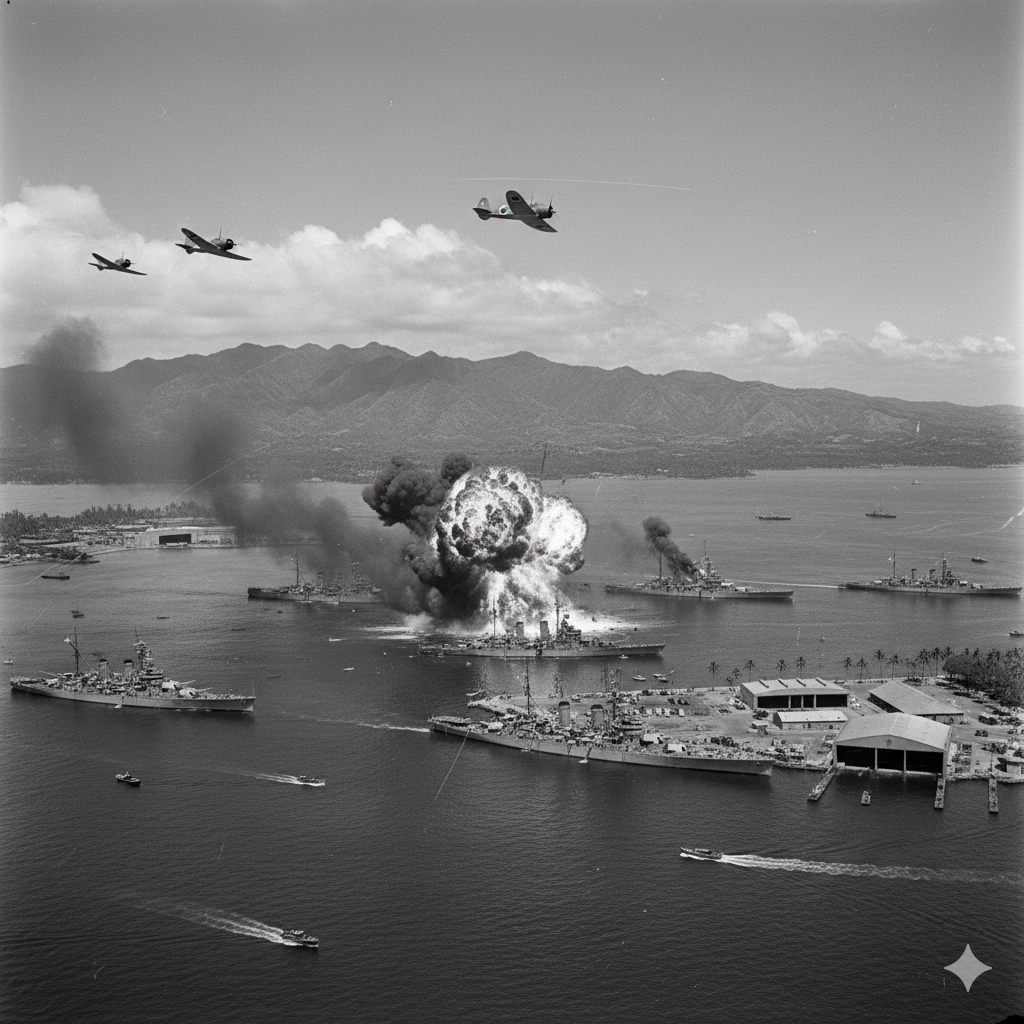
The 1941 attack on Pearl Harbor remains one of the most pivotal and sobering moments in modern history, a day that President Franklin D. Roosevelt declared “will live in infamy.” Remembering this event is not merely an act of memorializing the bravery and sacrifice of the 2,403 Americans who died; it is a vital, ongoing commitment to understanding the fragility of peace and the imperative for a robust international order. The sudden, devastating nature of the Japanese sneak attack was a traumatic shock that shattered America’s lingering isolationism and highlighted the fundamental need for strong international law, a powerful United Nations (UN), and arguably, an independent UN military force to prevent such unprovoked aggression from ever recurring.
The Pearl Harbor Catalyst: Law and Collective Security 🚨
The attack on Pearl Harbor was not just a military operation; it was a profound violation of international law. The Third Hague Convention of 1907 explicitly required a “previous and explicit warning, in the form either of a reasoned declaration of war or of an ultimatum with conditional declaration.” Japan’s failure to deliver this warning cemented the attack as a war crime and a symbol of deliberate treachery.
The global trauma of two World Wars, with Pearl Harbor as a key turning point in the second, directly informed the creation of the United Nations. The world recognized that treaties alone were insufficient; they required a collective security mechanism with genuine authority. The attack demonstrated three critical needs that led to the UN’s formation:
- Strict Adherence to International Law: Pearl Harbor underscored that the very foundation of global peace rests on the principle that nations must abide by established rules, particularly regarding the initiation of hostilities.
- A Mechanism for Collective Defense: The attack proved that no nation could remain safely isolated. The UN Charter’s framework for collective security—that an attack on one member is an attack on all—is a direct response to the aggressive unilateralism that culminated in Pearl Harbor.
- Proactive International Authority: The element of surprise at Pearl Harbor showed that global bodies must be vigilant, equipped to act swiftly, and authorized to intervene before aggression escalates into global war.
Lessons from Past Failures: The League of Nations vs. The UN Today
The United Nations was created in 1945, explicitly designed to avoid the institutional weaknesses that doomed its predecessor, the League of Nations, which failed to prevent the military expansionism that led to World War II, including the aggression by Imperial Japan.
| League of Nations | UN Challenges Today |
| Lack of Universal Membership: The United States never joined, significantly crippling its authority and resources. | Security Council Veto Power: The permanent five members (P5) can veto any substantive resolution, often paralyzing action against genocide or aggression when their own interests or those of their allies are involved. |
| Lack of Enforcement Power: The League had no standing army and relied on member states’ willingness to enforce resolutions, which often failed during crises like Italy’s invasion of Abyssinia (Ethiopia). | Dependence on Member State Forces: The UN relies on ad hoc contributions of troops for peacekeeping, leading to problems with command, control, training, and political will for deployment in high-risk zones. |
| Requirement for Unanimity: Major decisions required unanimous consent, making it easy for any single aggressive state (like Japan or Italy before they withdrew) to block effective action. | National Self-Interest vs. Global Good: Major powers often prioritize national interests, making it difficult to forge a unified, timely response to humanitarian crises or acts of war. |
While the UN has enjoyed significant successes, including vast humanitarian aid and preventing some wars, the recurring paralysis on the Security Council—a direct result of the P5 veto—echoes the League’s fundamental inability to act decisively against great-power aggression.
The Call for an Independent UN Military 🛡️
To truly fulfill the promise born from the ashes of Pearl Harbor and the failures of the League, many argue the UN must move beyond its current structure and establish a small, highly-trained, and independent standing military force.
- Bypassing Political Paralysis: Such a force, answerable only to the UN Secretary-General or a reformed Security Council without a veto, could respond immediately to egregious violations of international law, humanitarian crises, and surprise attacks like Pearl Harbor.
- Credible Deterrence: An internationally recruited, permanent military corps would provide the “teeth” that the League of Nations lacked. It would present a credible, non-national threat of force against clear aggressors, deterring them from action and strengthening the UN’s moral authority.
- Standardized Capabilities: Relying on ad hoc troop contributions leads to major issues in training, equipment, and military culture. An independent force would ensure a unified, professional, and rapid response capability, maximizing effectiveness and minimizing casualties.
Pearl Harbor was a devastating demonstration of what happens when a militaristic power acts without fear of a concerted, immediate international response. The tragedy forever changed America’s view of its place in the world and spurred the creation of an international body dedicated to collective security. Today, remembering the “day of infamy” must serve as a continuous call to action: a reminder to strengthen international law, to reform the UN to overcome the paralysis of national self-interest, and to consider bold new ideas, like an independent UN military, to ensure that the surprise, scale, and shock of Pearl Harbor are confined forever to the history books.