The Unburdened Mind: Advancing Education as a Universal Right
The pursuit of knowledge is not a luxury item to be purchased, but a fundamental human right and the most potent engine of collective prosperity. Yet, in many developed nations, higher education has been commodified, leading to crippling student loan debt that suppresses economic vitality and inhibits social mobility. A radical restructuring of this system is required, one that simultaneously cancels existing student loan debt, establishes tuition-free college education, and, critically, institutes rigorous academic standards to ensure the integrity of scholarly degrees. Furthermore, the establishment of a globally-managed university system, financed by the United Nations (UN), represents the necessary next step in realizing education’s universal potential.The Unburdened Mind: Advancing Education as a Universal Right
The pursuit of knowledge is not a luxury item to be purchased, but a fundamental human right and the most potent engine of collective prosperity. Yet, in many developed nations, higher education has been commodified, leading to crippling student loan debt that suppresses economic vitality and inhibits social mobility. A radical restructuring of this system is required, one that simultaneously cancels existing student loan debt, establishes tuition-free college education, and, critically, institutes rigorous academic standards to ensure the integrity of scholarly degrees. Furthermore, the establishment of a globally-managed university system, financed by the United Nations (UN), represents the necessary next step in realizing education’s universal potential.
The immediate cancellation of all outstanding student loan debt is not merely a moral plea; it is a direct and powerful economic stimulus. The burden of debt, now totaling trillions of dollars, acts as a profound drag on global economic activity, forcing millions of graduates—particularly young professionals and those from historically disadvantaged backgrounds—to postpone key wealth-building activities such as buying homes, starting families, and launching small businesses. Studies have consistently shown that debt relief frees up substantial monthly cash flow, directly translating into increased consumer spending. By removing this financial anchor, societies empower a generation to participate fully in the consumption cycle, boosting demand, stimulating job creation, and fostering entrepreneurship. This macroeconomic injection, funded by sovereign treasuries, provides a superior return on investment by unlocking the suppressed economic potential of its most educated citizens.
To prevent the cycle of debt from resuming, higher education must be universally free at the point of access. As articulated in the Universal Declaration of Human Rights, education, including technical and higher education, should be “equally accessible to all on the basis of merit.” If a post-secondary degree is now a prerequisite for economic participation, it must be treated as a public good, much like primary and secondary schooling. However, universal access must be paired with fiercely strict academic standards. Concerns that free tuition could devalue a degree by attracting uncommitted students must be directly addressed through rigorous admissions requirements, high mandatory grade point averages (GPA) for course continuation, and demanding graduation criteria. This dual system—universal access predicated on meritocratic performance—ensures that degrees retain their value, producing highly skilled, motivated graduates while removing the financial barrier that currently excludes brilliant minds based solely on income.
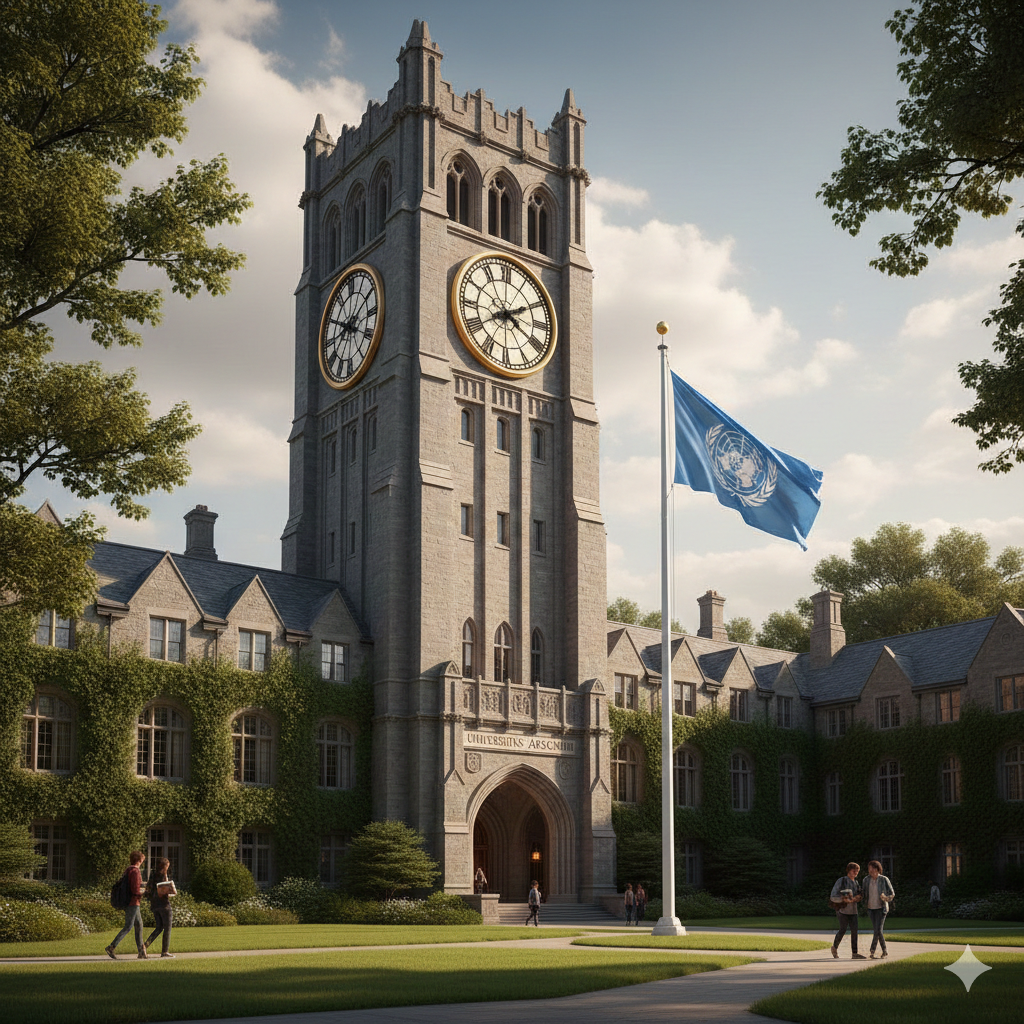
Finally, the global educational landscape must reflect the principle that knowledge belongs to humanity, not just to individual nations or private entities. The United Nations, as the preeminent body for international cooperation, should establish and oversee a network of flagship universities—the Universitas Mundi—dedicated to global research, intercultural understanding, and sustainable development. These institutions would be funded through a modest, progressive global income tax levied on all individuals worldwide. Even a minuscule contribution from global earnings could generate vast, stable funding streams to sustain these universities, offering degrees at the pinnacle of academic excellence to qualified students from every continent. Such a system would not only fulfill the international obligation to treat education as a right, but it would also cultivate a globally-minded cadre of leaders and thinkers capable of tackling planetary challenges, from climate change to public health, through a truly unified human effort.
In conclusion, transforming the current system from a debt-fueled market to a right-based public good is necessary for both economic stability and moral coherence. By canceling existing loans, we inject immediate stimulus; by providing free education tied to rigorous standards, we secure the value of future degrees; and by establishing UN-governed institutions, we affirm the universality of knowledge. Education is the bedrock of democracy and progress, and only by unburdening the minds of its citizens can the world truly realize its collective potential.
The immediate cancellation of all outstanding student loan debt is not merely a moral plea; it is a direct and powerful economic stimulus. The burden of debt, now totaling trillions of dollars, acts as a profound drag on global economic activity, forcing millions of graduates—particularly young professionals and those from historically disadvantaged backgrounds—to postpone key wealth-building activities such as buying homes, starting families, and launching small businesses. Studies have consistently shown that debt relief frees up substantial monthly cash flow, directly translating into increased consumer spending. By removing this financial anchor, societies empower a generation to participate fully in the consumption cycle, boosting demand, stimulating job creation, and fostering entrepreneurship. This macroeconomic injection, funded by sovereign treasuries, provides a superior return on investment by unlocking the suppressed economic potential of its most educated citizens.
To prevent the cycle of debt from resuming, higher education must be universally free at the point of access. As articulated in the Universal Declaration of Human Rights, education, including technical and higher education, should be “equally accessible to all on the basis of merit.” If a post-secondary degree is now a prerequisite for economic participation, it must be treated as a public good, much like primary and secondary schooling. However, universal access must be paired with fiercely strict academic standards. Concerns that free tuition could devalue a degree by attracting uncommitted students must be directly addressed through rigorous admissions requirements, high mandatory grade point averages (GPA) for course continuation, and demanding graduation criteria. This dual system—universal access predicated on meritocratic performance—ensures that degrees retain their value, producing highly skilled, motivated graduates while removing the financial barrier that currently excludes brilliant minds based solely on income.
Finally, the global educational landscape must reflect the principle that knowledge belongs to humanity, not just to individual nations or private entities. The United Nations, as the preeminent body for international cooperation, should establish and oversee a network of flagship universities—the Universitas Mundi—dedicated to global research, intercultural understanding, and sustainable development. These institutions would be funded through a modest, progressive global income tax levied on all individuals worldwide. Even a minuscule contribution from global earnings could generate vast, stable funding streams to sustain these universities, offering degrees at the pinnacle of academic excellence to qualified students from every continent. Such a system would not only fulfill the international obligation to treat education as a right, but it would also cultivate a globally-minded cadre of leaders and thinkers capable of tackling planetary challenges, from climate change to public health, through a truly unified human effort.
In conclusion, transforming the current system from a debt-fueled market to a right-based public good is necessary for both economic stability and moral coherence. By canceling existing loans, we inject immediate stimulus; by providing free education tied to rigorous standards, we secure the value of future degrees; and by establishing UN-governed institutions, we affirm the universality of knowledge. Education is the bedrock of democracy and progress, and only by unburdening the minds of its citizens can the world truly realize its collective potential.