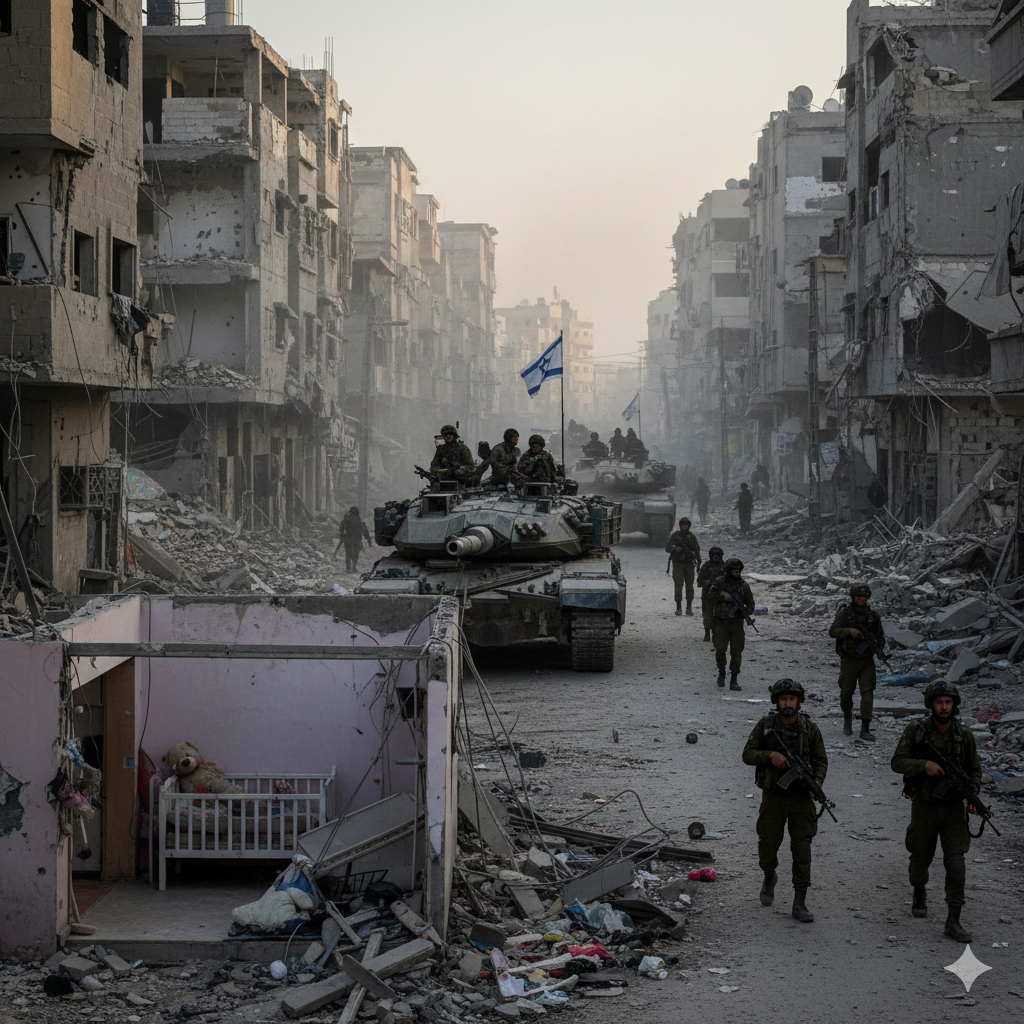
The Gaza Crisis, Genocide, and the Failure of Global Governance
The humanitarian catastrophe unfolding in the Gaza Strip represents more than a conflict; it is a profound failure of the international system to uphold its most fundamental laws and principles. Rooted in an occupation that has persisted since 1967—and which many international bodies affirm continues despite the 2005 disengagement due to Israel’s control over Gaza’s borders, airspace, and sea—the crisis has metastasized into a political and legal debate centering on the charge of genocide. This situation demands an unequivocal accounting of international law, the prosecution of responsible leaders by institutions like the International Criminal Court (ICC), and a radical restructuring of the United Nations (UN) to ensure its efficacy, perhaps even granting it the enforcement powers of a dedicated military force.
The legal and ethical weight of terming Israel’s actions a “genocide” stems from the catastrophic loss of life and the systematic destruction of civilian infrastructure essential for survival. While Israel maintains its actions are legitimate self-defense against terror groups, critics argue that the sheer scale of the military operations, combined with restrictions on food, water, medical aid, and energy, demonstrates a deliberate strategy to inflict “conditions of life calculated to bring about [the] physical destruction” of the Palestinian population in Gaza, an act prohibited under Article II of the 1948 Genocide Convention. The high death toll of civilians, the targeting of aid convoys, and the displacement of nearly the entire population into ever-shrinking, unliveable zones have led human rights organizations and UN bodies to conclude that sufficient grounds exist to investigate and prosecute this charge.
This context of systematic destruction elevates the necessity for justice through the International Criminal Court. The ICC, mandated to prosecute individuals responsible for the most serious crimes of concern to the international community—genocide, war crimes, and crimes against humanity—is the appropriate venue for accountability. Calls for Israeli leaders and military commanders to face trial by the ICC are not merely political rhetoric; they are a demand that the principles of international law be applied universally. A successful prosecution and guilty verdict would not only deliver justice for the victims but also reaffirm the rule of law, dismantling the impunity that has shielded powerful states from accountability for decades. The pursuit of justice must be unyielding, ensuring that no head of state is above the law when the crime of genocide is alleged.
Ultimately, the crisis in Gaza exposes the debilitating weakness of the global security architecture, specifically the United Nations. Although the UN has been central to the Israeli-Palestinian issue since 1947, its primary mechanisms for peacekeeping and conflict resolution—the Security Council—are paralyzed by the veto power held by its five permanent members. This structural flaw allows geopolitical interests to consistently override humanitarian imperatives, rendering the organization ineffective in stopping large-scale human rights abuses. Resolutions demanding ceasefires and humanitarian access are routinely undermined or ignored, demonstrating that the UN lacks the “teeth” necessary to enforce its own mandates.
The most radical, yet necessary, conclusion drawn from this chronic failure is the need for a more effective and powerful UN, one potentially backed by its own dedicated military force. Current UN peacekeeping missions rely on ad hoc contributions from member states, which are often slow to deploy, underequipped, and constrained by narrow, non-enforcement mandates. A standing UN military force, trained and commanded directly by the international body, would bypass the crippling political gridlock of the Security Council’s veto power and provide a rapid, impartial response capability. Such a force would not serve the national interests of any single state but the common human interest in preventing crimes against humanity and maintaining peace. While the creation of such a force presents enormous logistical and political hurdles, its existence would fundamentally shift the dynamic of international crises like Gaza, moving the world closer to a system where collective security is a guarantee, not a disposable option.
The occupation and the resulting crisis in Gaza stand as a testament to the international community’s failure to prevent mass atrocity. Achieving a just resolution requires simultaneous action: the relentless pursuit of individual accountability through the ICC to prosecute those potentially responsible for genocide, and a bold, transformative reform of the UN to grant it the authority and military capacity to enforce international law. Only by holding leaders accountable and empowering the global body responsible for peace can the world hope to prevent the repetition of such devastating humanitarian disasters.