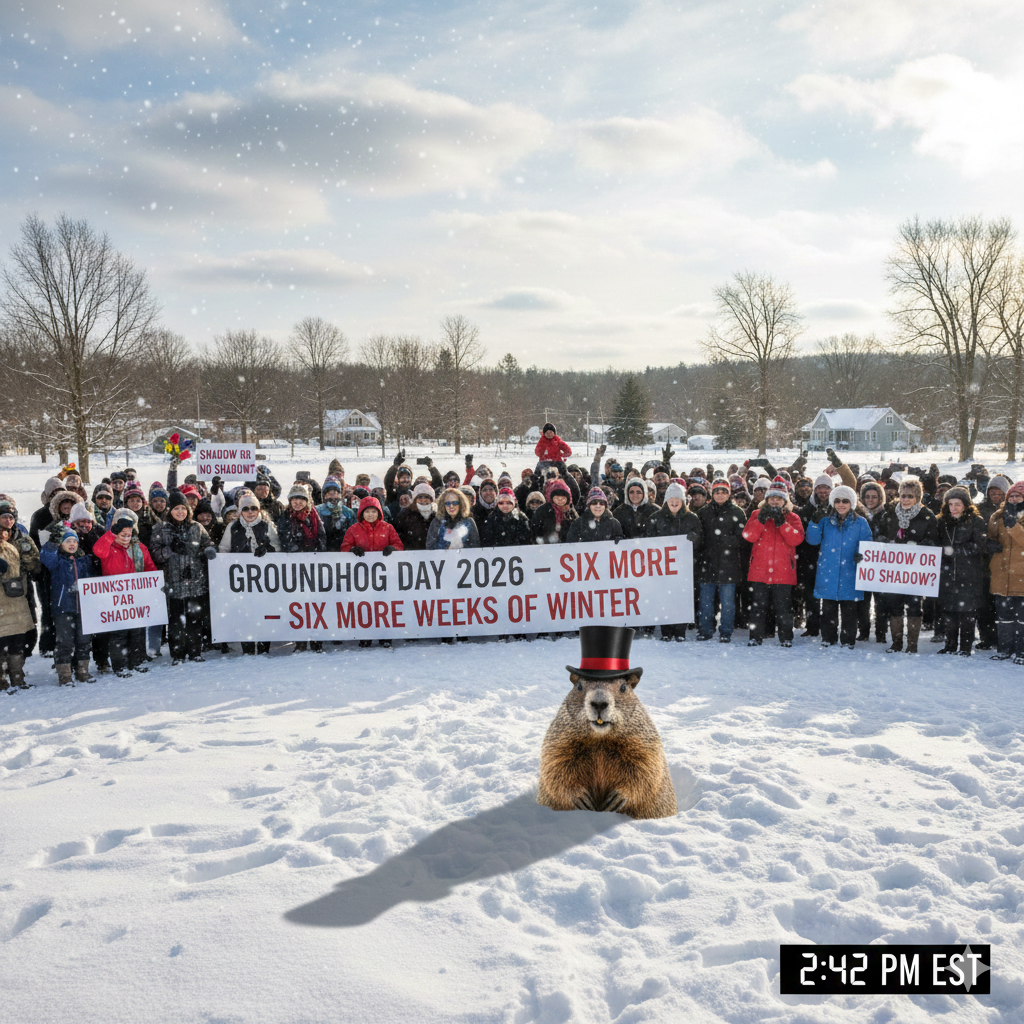
The Shadow of Tradition: The History and Science of Groundhog Day
Every February 2nd, a curious ritual unfolds in the small town of Punxsutawney, Pennsylvania. A crowd gathers at Gobbler’s Knob to watch a groundhog named Phil emerge from his burrow. If he sees his shadow, we are told to expect six more weeks of winter; if not, spring is supposedly just around the corner. While Groundhog Day is a charming piece of Americana, it serves as a perfect case study for how we balance cultural heritage with a commitment to scientific literacy.
Roots in the Old World
The origins of Groundhog Day are a blend of Christian tradition and ancient folklore. It traces back to Candlemas, a Christian holiday marking the midpoint between the winter solstice and the spring equinox. European clergy would bless candles for the winter, and a popular folk rhyme emerged:
If Candlemas be fair and bright,
Come, Winter, have another flight;
If Candlemas brings clouds and rain,
Go, Winter, and come not again.
The Germans took this a step further by introducing an animal—the badger—into the lore. When German settlers arrived in Pennsylvania in the 18th and 19th centuries, they brought the tradition with them, substituting the plentiful local groundhog for the badger. In 1887, the Punxsutawney Groundhog Club declared Phil the “official” weather-prognosticating marmot, cementing the tradition in the American consciousness.
The Value of the Ritual
Why do we keep doing this? It isn’t because we actually believe a rodent has meteorological superpowers. Traditions like Groundhog Day are important because they:
- Foster Community: They provide a shared cultural moment that breaks the monotony of the “winter blues.”
- Connect us to History: They act as a living museum, reminding us of our ancestors’ agrarian lifestyles and their intimate relationship with the changing seasons.
- Inject Whimsy: In a world of complex global issues, there is something harmlessly fun about a town celebrating a furry forecaster.
The Danger of Pseudoscience
However, there is a line between celebration and credulity. As much as we enjoy the pageantry, we must be careful not to let these traditions bleed into “pseudoscience”—the practice of presenting claims as scientific when they lack evidence or a logical methodology.
The “science” of Phil’s shadow is non-existent. Statistically, the groundhog’s accuracy rate is roughly 39% to 40%, which is significantly worse than a simple coin toss. Believing that a localized shadow in Pennsylvania can dictate the atmospheric patterns of an entire continent is not just whimsical; it is a rejection of how global weather systems actually work.
Letting Science Lead
In an era where misinformation can spread rapidly, it is vital to remember that true science must lead. Meteorology is a rigorous field involving satellite data, thermodynamics, and complex fluid dynamics. Our understanding of the climate should be rooted in the scientific method—observation, hypothesis, and peer-reviewed data—rather than folklore.
The takeaway: We can enjoy the groundhog, but we should trust the barometers and the meteorologists. One is for the heart; the other is for the head.
By treating Groundhog Day as a cultural performance rather than a scientific prediction, we preserve our heritage without sacrificing our intellectual integrity. We can appreciate the shadow while keeping our eyes firmly on the facts.