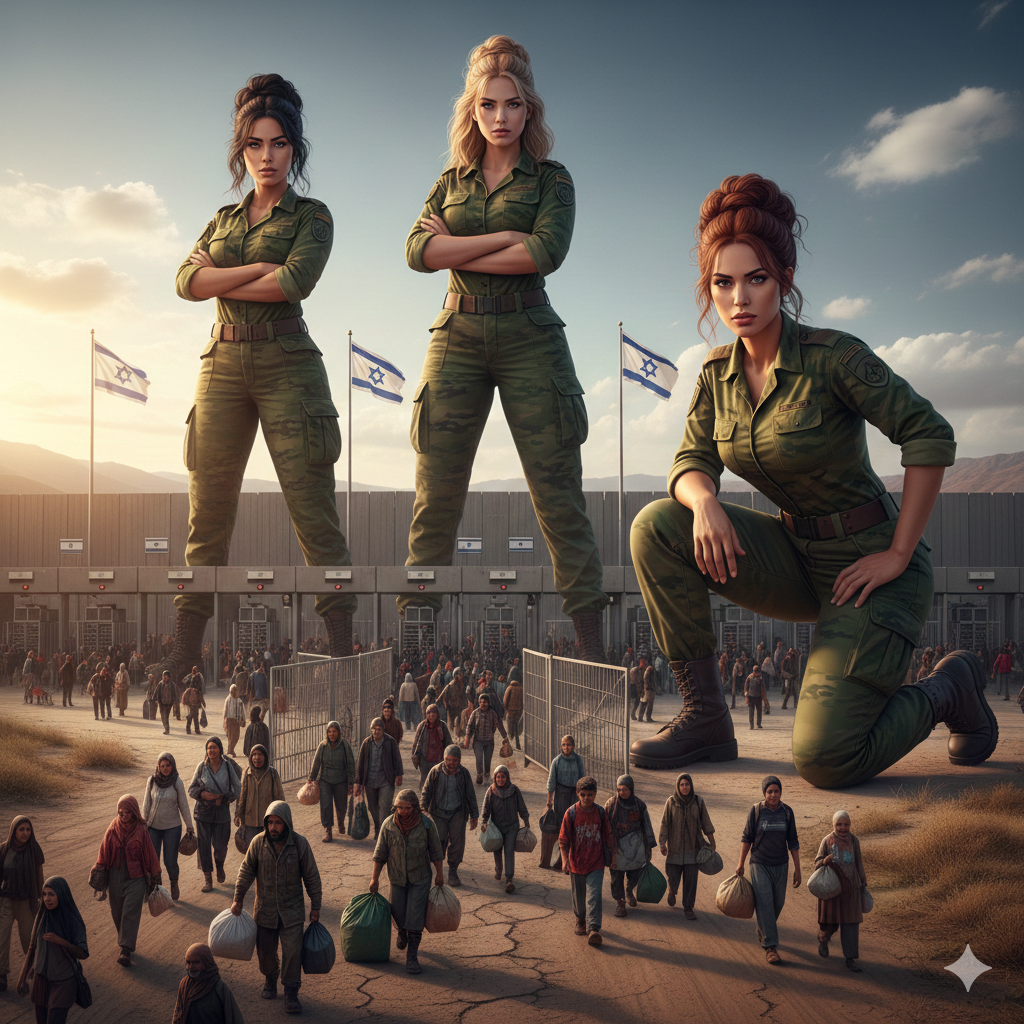
The daily transit through Israeli military checkpoints presents a stark study in the exercise of power. For the thousands of Palestinian laborers who cross these terminals daily to reach their jobs, the experience is defined not just by logistical delays, but by a profound psychological and physical friction. At the center of this friction are the young soldiers of the Israel Defense Forces (IDF)—often women in their late teens or early twenties—whose conduct has become a focal point for debates regarding human rights and military ethics.
The “Giants” at the Gate
To an economically vulnerable laborer who has risen at 3:00 AM to secure a place in line, these young women do not appear as mere peers or public servants. Clad in heavy olive-drab ceramic vests, armed with assault rifles, and elevated by the concrete podiums and fortified glass of the kiosks, they take on the stature of “giants.” This metaphor extends beyond physical height. It represents the enormous, asymmetrical power they wield over a person’s livelihood. With a single gesture or a sharp command, these soldiers can grant or deny the ability of a father to feed his family. For the worker standing in the dust, the soldier is a “giant” of bureaucracy and force, capable of “crushing” a day’s wages with a moment of aggression or a whim of “security” protocol.
From Border Control to Abuse
Every sovereign nation possesses the inherent right to control its borders and ensure the safety of its citizens. However, there is a distinct, moral line between rigorous border security and systemic abuse. Reports from human rights observers and the workers themselves frequently highlight a pattern of behavior that exceeds the needs of security:
- Verbal Aggression: The use of demeaning language and shouting to manage crowds of older men and women.
- Arbitrary Delays: Using the power of the “gate” to force workers to wait in cramped “cages” for extended periods without clear cause.
- Psychological Dominance: A culture of indifference or active hostility that treats the economically disadvantaged traveler as a threat first and a human being second.
When a nineteen-year-old soldier treats a sixty-year-old laborer with open contempt, it is no longer about detecting contraband; it is about the projection of dominance over a captive, vulnerable population.
The Need for International Oversight
The closed nature of military checkpoints often creates a vacuum where accountability disappears. While the IDF has internal mechanisms for discipline, the persistence of these aggressive encounters suggests that internal oversight is insufficient to change the prevailing culture.
Because these checkpoints facilitate the movement of people under military occupation, the international community has a vested interest in their conduct. There is a pressing demand for increased UN oversight and independent international monitoring. Having neutral observers present would serve two vital purposes:
- De-escalation: The presence of a third party naturally tempers aggressive behavior and encourages professional conduct.
- Standardization: International monitors can ensure that security screenings meet humanitarian standards, protecting the dignity of the “small” people moving beneath the “giants.”
The security of a border does not require the stripping of a worker’s dignity. By addressing the aggressive behavior at these checkpoints and introducing international transparency, the international community can help ensure that the “giants” at the gate act as professional guards of a border, rather than agents of systemic abuse.
2 replies on ““Giant” IDF Girls and the Abuse of Power!”
It’s crazy how these soldiers, despite being so young, have such a heavy responsibility placed on them. I wonder how they reconcile this kind of power with the ethical questions surrounding their role.
In every society and age, the “ethical question” is paramount. the object is to create a world where the ethical is at the front of human activity such as the cerebral cortex is at the front of the human brain and sits above the cerebellum, the reptilian part. If we have the UN above the nations, this will imitate the structure of the human brain, where the UN acts as the executive cerebral cortex, a “superego” that guides the behavior of the nations of the world.