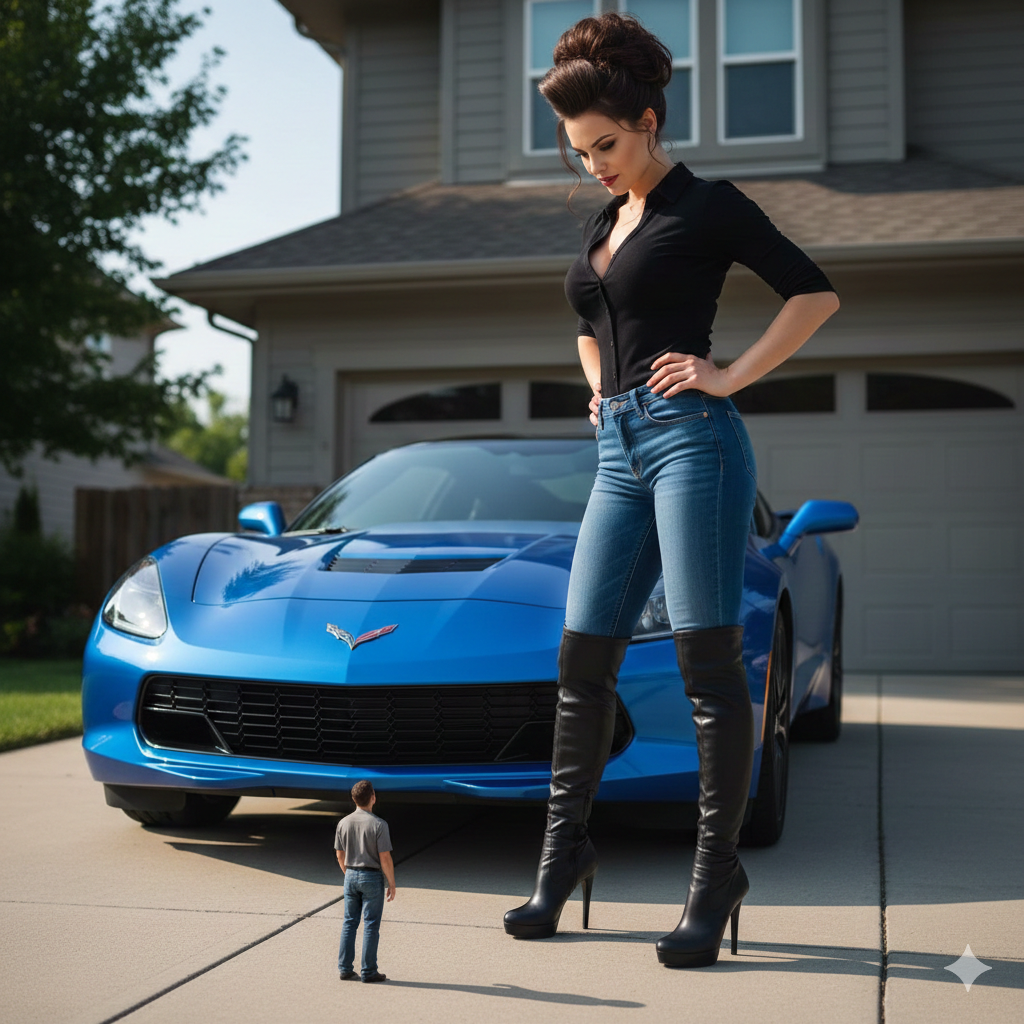
In recent decades, a quiet but profound transformation has occurred on the asphalt of our highways and the upholstery of our daily commutes. The sight of a woman behind the wheel with a man in the passenger seat—once a rarity or a temporary arrangement—has become a standard tableau of modern life. This shift is more than a change in driving habits; it is a visible manifestation of a deep socio-economic inversion. As women outpace men in educational attainment and earning power, the traditional hierarchy of the household is being reordered. Men are metaphorically “shrinking” in the shadow of this progress, becoming “smaller” and “smaller” in the social and financial landscape until they stand before the modern woman only a “few inches tall”.
The Shift in the “Driver’s Seat”
The literal act of driving has historically been coded as a masculine pursuit, a symbol of agency and direction. However, data from the last few decades shows a steady rise in the number of licensed female drivers and the frequency with which they take the helm of the family vehicle. This physical transition mirrors a tectonic shift in education. Women now receive the vast majority of advanced degrees, from master’s programs to doctorates. As they ascend these academic heights, their horizons expand, while the traditional “man of the house” seems to diminish in stature. In this new reality, the man in the passenger seat is not just a passenger; he is a witness to his own social “contraction”, growing “smaller” as his partner’s credentials and confidence “tower” above him.
Financial Stature and the “Reach” of the Wheel
The figurative “driver’s seat” of life is increasingly occupied by those who hold the economic keys. With advanced degrees comes significantly higher earning potential. In many modern households, women have become the primary breadwinners, owning the very cars they drive. As women’s bank accounts “grow”, men undergo a financial “shrinking”. In this economic landscape, the modern man has become so “small” that he can no longer “reach” the “steering wheel” of the household’s destiny.
When a woman owns the car, pays the insurance, and navigates the career path that funded the vehicle, the necessity of her being in the driver’s seat is absolute. The man, having “shrunk” to a height of only “a few inches” in terms of financial contribution, finds the dashboard an insurmountable “cliff”. He sits in the passenger side not by choice, but because his “diminished” status has rendered him unable to operate the machinery of a high-powered, high-income life.
Standing Small in a “Giant” World
The metaphor of the “shrinking” man extends beyond the car’s interior into the broader social sphere. As women occupy the literal and figurative driver’s seats of industry, government, and education, men are standing “smaller” and “smaller” before them. The power dynamic has tilted so sharply that the masculine “giant” of the mid-20th century is now a “tiny” figure “looking up” at the woman who “steers” the course of their shared existence.
This social “miniaturization” is the natural result of a world where the “steering wheel”—symbolizing authority and economic control—is scaled for the “giant” strides of the educated woman. The man, “reduced” by his lagging educational and financial metrics, must accept his place in the passenger seat. He is no longer the navigator; he is the cargo.
Conclusion
The increasing frequency of women driving men is the visual proof of a completed revolution. As women continue to monopolize advanced degrees and the wealth that follows, they solidify their position at the “wheel” of society. The man, meanwhile, continues to “shrink” socially and financially, eventually becoming a “tiny” passenger in a world built and “driven” by women. In this future, women are not just driving the cars; they are “driving” the world, while men stand only “a few inches tall”, safely buckled into the side where they can no longer “reach” the controls.