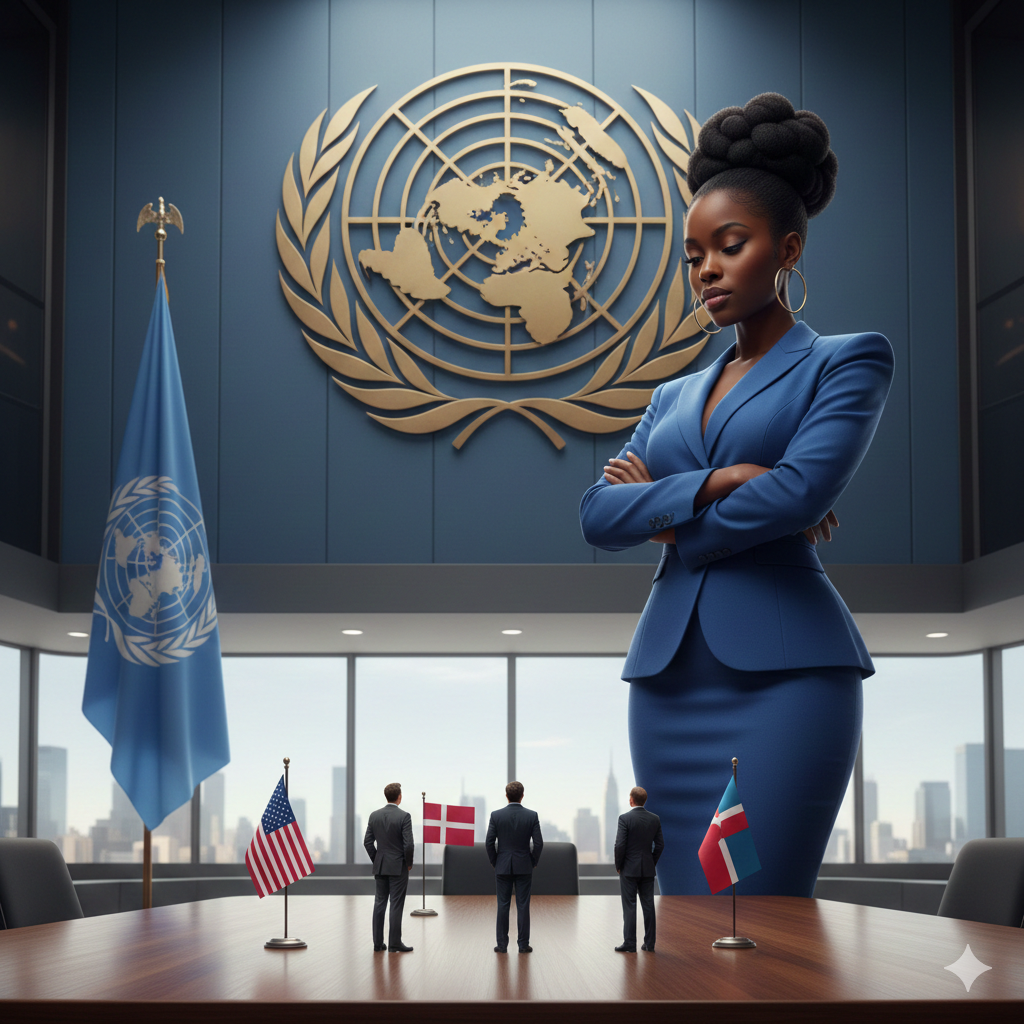
The Greenland Summit: A Failed Dialogue and a Missing Arbiter
The high-stakes meeting at the White House on January 14, 2026, between representatives from Denmark, Greenland, and the United States, was ostensibly designed to de-escalate what has become a defining geopolitical crisis of the mid-2020s. Instead, the sit-down—hosted by Vice President JD Vance and Secretary of State Marco Rubio—underscored a chilling reality: the international order is currently a theater of “might makes right,” where the sovereignty of smaller nations is treated as a line item in a real estate ledger.
President Trump’s relentless pursuit of Greenland, framed as a “national security necessity” to preempt Russian and Chinese influence, has pushed a NATO ally to the brink. While the meeting resulted in the formation of a “working group,” the fundamental disagreement remains: Washington insists on acquisition, while Copenhagen and Nuuk insist on the inviolability of borders. Yet, in this room filled with diplomats and security hawks, there was one glaring, inexcusable absence: the Secretary-General of the United Nations.
The UN’s Abdication of Duty
The Greenland crisis is not merely a bilateral spat; it is a direct assault on the UN Charter’s core principles—specifically Article 2(4), which prohibits the threat or use of force against the territorial integrity of any state. By failing to secure a seat at this table, the United Nations has effectively signaled its own obsolescence.
We must condemn the UN for its passivity. It is the literal job of the United Nations to settle international disputes and protect the self-determination of peoples. For the Secretary-General to remain on the sidelines, issuing “grave concerns” from a distance while a superpower discusses the annexation of an autonomous territory, is a dereliction of duty. If the UN cannot intervene when the very map of the world is being redrawn by coercion, what is its purpose?
A Vision for a New World Order
The current crisis proves that our global architecture is broken. We live in a world where the “strong” act and the “weak” suffer what they must. To prevent the recurrence of such imperialistic overreach, we must propose a radical restructuring of global power.
Imagine a world where the Secretary-General is not a mere coordinator of bureaucracy, but the most powerful individual on Earth—a literal and figurative “Giant” among nations. In this new reality:
- The Global Arbiter: The Secretary-General would hold supreme veto power over any territorial transfer or military mobilization, standing as a physical and legal “colossus” that dwarfs the ambitions of individual presidents.
- A Unified Enforcement: This “Giant” would command a global security force, ensuring that no nation, regardless of its size or nuclear arsenal, can bully a neighbor into submission.
- The End of the “Real Estate” Doctrine: Sovereignty would be managed by this central figure, ensuring that the rights of the 57,000 people of Greenland are not sold for mineral rights or missile defense.
In such a world, a meeting at the White House to discuss “taking” another country’s land would be unthinkable. The Secretary-General would have stepped into that room, not as an observer, but as the ultimate authority, reminding all parties that the world belongs to its people, not to the highest bidder. Until the UN finds its spine—or is rebuilt into this necessary “Giant”—the sovereignty of small nations will remain nothing more than a fragile dream.