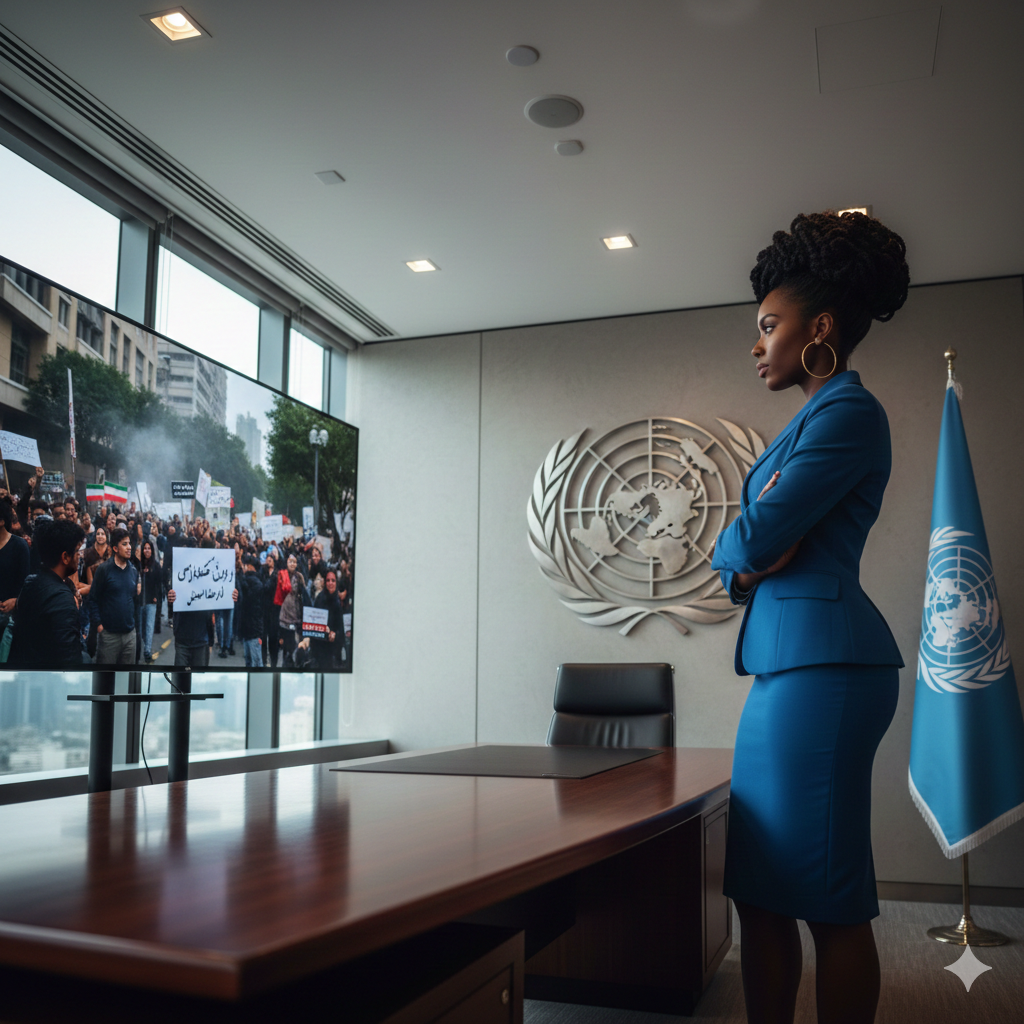
The Iranian Crisis: A Mandate for Multilateral Action
The dawn of 2026 has found Iran at a critical crossroads. Since late December 2025, a wave of civil and political unrest has swept through all 31 provinces, ignited by a collapsing economy and record inflation, but rapidly evolving into a fundamental challenge to the legitimacy of the Islamic Republic. As security forces—including the Islamic Revolutionary Guard Corps (IRGC)—deploy lethal force, the international community faces a familiar dilemma. However, the historical record suggests that the solution does not lie in the unilateral intervention of the United States. Instead, the current crisis presents a unique and necessary opportunity for the United Nations to assert its authority, enforce its Charter, and facilitate a transition from an autocratic theocracy to a productive, democratic socialist society.
The Limits of Unilateralism
For decades, the burden of “solving” Middle Eastern crises has often fallen upon the United States. Yet, history has shown that unilateral regime change often yields unintended and disastrous consequences. From the 1953 coup in Iran to the more recent invasions of Iraq and Afghanistan, foreign-led overthrows without broad international legitimacy frequently result in power vacuums, civil war, and the rise of even more radical factions.
In the current context, a U.S.-led intervention would likely be characterized by the Iranian regime as “Western imperialism,” potentially rallying nationalist sentiment around a failing government. To avoid the “treacherous temptation” of unilateralism, the global community must recognize that the crisis in Iran is not a bilateral dispute between Washington and Tehran, but a violation of the universal principles upon which the modern international order was built.
The UN Mandate: Beyond Documentation
The United Nations has historically limited its role in Iran to “fact-finding missions” and the publication of human rights reports. While these efforts are vital for documenting the “systematic impunity” and “crimes against humanity” reported by the UN Human Rights Chief in early 2026, they have done little to stop the cycle of violence.
The UN Charter and the Universal Declaration of Human Rights are not merely aspirational documents; they are the legal bedrock of the family of nations. Article 18 of the UDHR explicitly guarantees freedom of thought, conscience, and religion. The Iranian theocracy, which prosecutes protesters for moharebeh (enmity against God) and enforces strict religious codes on non-Muslims and dissenters alike, stands in direct opposition to these mandates.
The UN should transition from a passive monitor to an active architect of change. By invoking the “Responsibility to Protect” (R2P), the UN can argue that the Iranian state has failed to protect its population from mass atrocity crimes, thereby forfeiting its sovereign immunity.
Toward a Democratic Socialist Iran
The goal of UN involvement should not simply be the removal of the current leadership, but the cultivation of an open society. This requires a transition to a democratic socialist framework that addresses the root causes of the 2025–26 protests:
- Economic Justice: Redistribution of the nation’s vast resource wealth to alleviate the poverty and record inflation currently strangling the working class.
- Religious Pluralism: Granting full religious and civil freedom to all citizens, ensuring that the state is a home for Muslims, Baha’is, Christians, and secularists alike.
- Productive Diplomacy: Integrating a post-theocratic Iran into the family of nations, ending its isolation and transforming it from a regional “axis of resistance” into a partner for stability.
Conclusion
The bravery of the Iranian people on the streets of Tehran and Kurdistan demands more than just “grave concern” from the international community. It requires a fundamental shift in global governance. By leading the charge for regime change and democratic reform, the United Nations can prove its relevance in the 21st century. It is time for the UN to fulfill its function: to ensure that the “dignity and worth of the human person” is not just a phrase in a charter, but a reality for every Iranian.