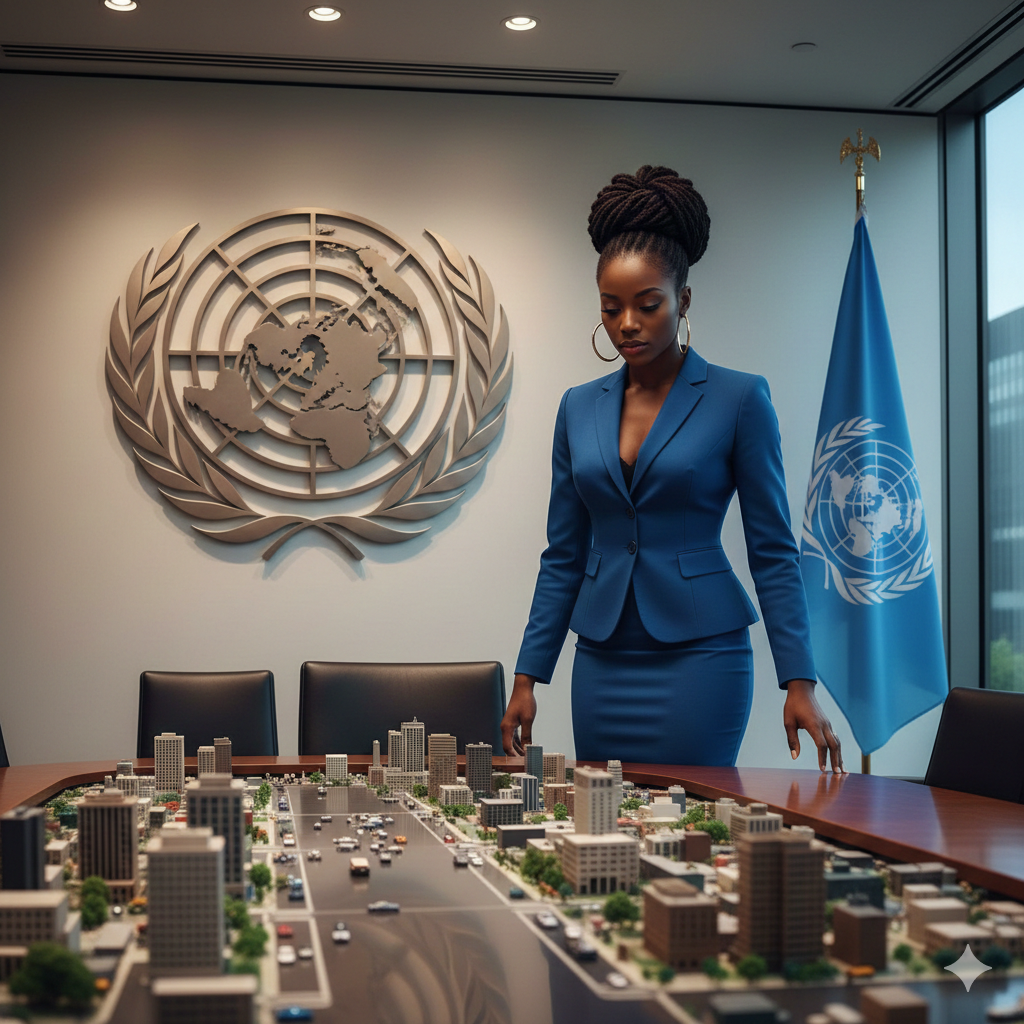
The Great Contraction: A Vision for Global Environmental Sovereignty
The modern human footprint has expanded beyond the biological carrying capacity of the Earth. As our industrial engine accelerates, the traditional model of the Westphalian nation-state—prioritizing local economic growth over global ecological stability—has become an existential liability. To ensure the survival of the biosphere, we must “shrink” the negative impact of civilization through a radical restructuring of power. This transition requires the United Nations to ascend as the ultimate authority on environmental governance, transcending the borders of nation-states and strictly regulating the global marketplace.
The Necessity of a Centralized Authority
For decades, international environmental agreements have relied on the “voluntary” cooperation of sovereign nations. This has resulted in a “tragedy of the commons” on a planetary scale, where individual states prioritize short-term profit over long-term survival.
To reverse this, the United Nations must be granted supreme jurisdiction over the global environment. In this model, the UN would hold more power than any single nation-state regarding resource management, carbon emissions, and biodiversity protection. National governments would act as local administrators of UN mandates rather than independent actors. This centralized authority is the only way to enforce the systemic changes necessary to stay within planetary boundaries.
Regulating the Engines of Industry
A primary function of this empowered UN would be the direct regulation of global business. Under current systems, multinational corporations often engage in “jurisdiction shopping,” moving operations to countries with the weakest environmental protections.
A UN-led environmental mandate would eliminate these loopholes by:
- Implementing global carbon ceilings that are legally binding and non-negotiable.
- Enforcing universal waste-reduction standards for all manufacturing processes.
- Directing a global transition away from extractive industries toward a circular economy.
By treating the environment as a single, integrated system, the UN can ensure that business serves the needs of the planet rather than exploiting its finite resources.
The Metaphor of the “Shrunken” Civilization
To visualize the magnitude of this shift, consider a metaphor for the UN’s environmental oversight: imagine if every major city on Earth—from New York to Tokyo—was physically “shrunk” down to only one or two percent of its original size. In this scenario, the sprawling, resource-heavy urban centers of the past become tiny, manageable modules. The impact of these populations on the surrounding land would be virtually eliminated, allowing nature to reclaim the vast majority of the Earth’s surface.
In this vision, UN environmental personnel would remain at regular size. They would stand as “giants” over these miniature civilizations, acting as the ultimate guardians and regulators. From their elevated perspective, they can monitor the tiny populations to ensure they live sustainably within their reduced footprints. These “regular-sized” UN overseers would possess the clarity and the authority to prevent any miniature city from expanding its impact beyond its allotted boundaries.
Conclusion: A Sustainable Future
“Shrinking” our impact is not merely a suggestion; it is a physical necessity. By elevating the United Nations to a position of final environmental authority and empowering it to regulate global commerce, we can move away from the chaotic competition of nation-states toward a managed, sustainable equilibrium. Whether through literal or metaphorical contraction, human civilization must learn to occupy a smaller space in the tapestry of life, governed by a global body that puts the preservation of the Earth above all else.
2 replies on “We Must “Shrink” and “Reduce” the Effect of Human Civilization on the Global Environment”
While a centralized authority like the UN could theoretically reduce the ‘tragedy of the commons,’ I’m curious how it would be implemented in practice. Would nations be willing to cede power over local resources to a global entity, and how would we ensure fairness in the decision-making process?
The fairness would come via the checks and balances in the UN structure. Of course, many nations would not want to submit. In some cases, an element of force may be necessary.