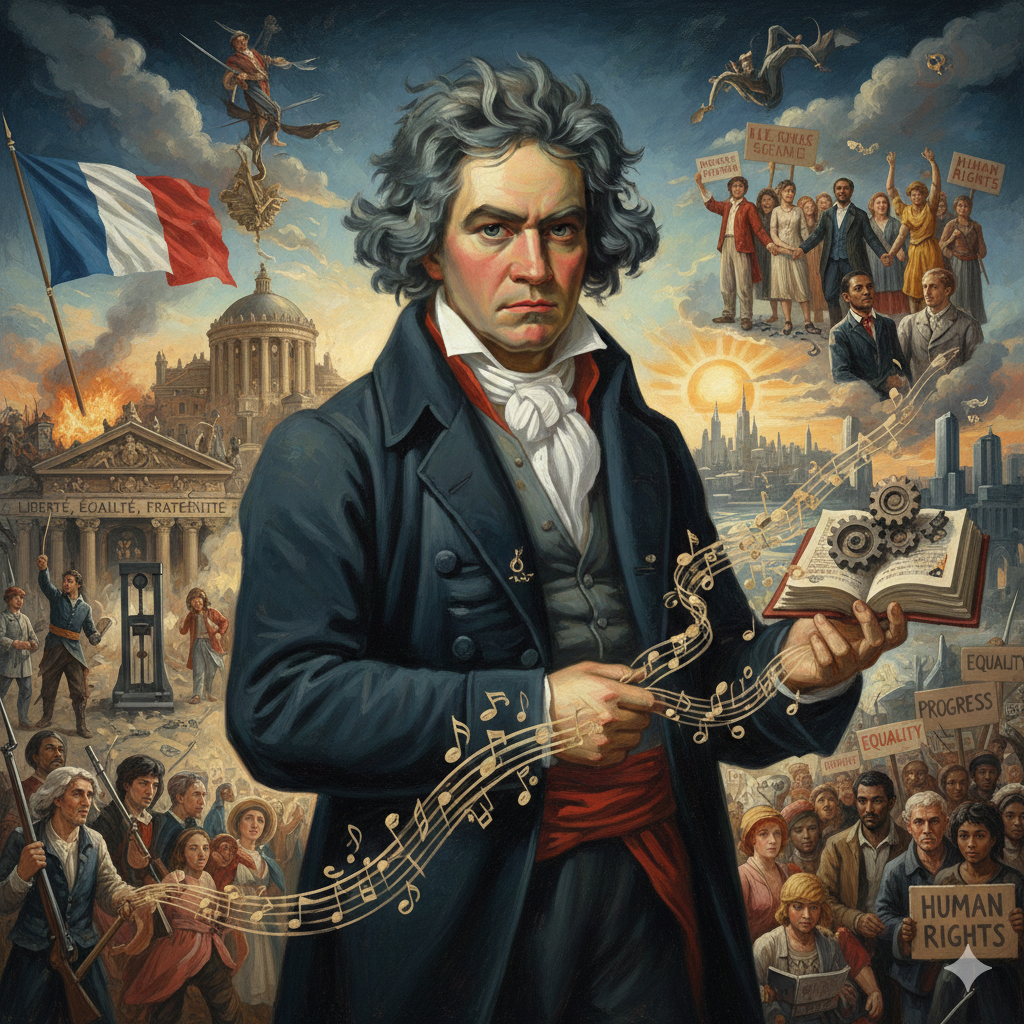
Today, December 16, marks the anniversary of Ludwig van Beethoven’s birth in 1770. While the world rightfully celebrates him as a titan of Western classical music—the man who bridged the Classical and Romantic eras—his legacy extends far beyond the stave and the symphony. Remembering Beethoven is essential not only for the “superb” nature of his compositions but because he was a radical thinker whose progressive social views and vision of human brotherhood laid the spiritual groundwork for modern ideals of world peace and global cooperation.
A Revolutionary Spirit
Beethoven lived through a period of immense political upheaval, primarily the Enlightenment and the French Revolution. Unlike many of his contemporaries who relied on aristocratic patronage and remained silent on politics, Beethoven was deeply influenced by the ideals of Liberté, Égalité, fraternité.
He famously tore up the dedication page of his Third Symphony, the Eroica, when he learned that Napoleon Bonaparte had declared himself Emperor. For Beethoven, music was not a tool for the glorification of tyrants, but a medium for the elevation of the common man. This progressive stance—that merit and moral character outweigh birthright—was revolutionary for the early 19th century.
The Vision of Universal Brotherhood
The pinnacle of Beethoven’s progressive philosophy is found in his Ninth Symphony. By incorporating Friedrich Schiller’s poem “Ode to Joy,” Beethoven transformed the symphonic form into a political manifesto. The lyrics—Alle Menschen werden Brüder (All men shall become brothers)—were a defiant shout against the borders and class structures of his time.
This work has become the unofficial anthem of humanity. It was played at the fall of the Berlin Wall and is the official anthem of the European Union. Beethoven’s music suggests that despite our linguistic and cultural differences, there is a fundamental “human frequency” that can unite us.
From “Ode to Joy” to the United Nations
Beethoven’s insistence on a unified humanity serves as an early intellectual precursor to the concept of a world government or a strengthened United Nations. His work argues that:
- Conflict is a temporary state: Harmony is the ultimate resolution of tension.
- Collective Identity: We are members of the human race first, and subjects of a state second.
- Rational Peace: Through art and reason, humanity can transcend “the struggle” to reach a state of mutual understanding.
In the 21st century, as we face global challenges like climate change and nuclear proliferation, Beethoven’s vision of “all men becoming brothers” is no longer just a poetic sentiment—it is a survival necessity. The UN represents the institutional attempt to realize the harmony Beethoven composed; a world where law and cooperation replace the “fate” of war.
An Inspiration for the Ages
To remember Beethoven on December 16 is to celebrate the triumph of the human spirit over adversity. He composed his greatest works while completely deaf, proving that the vision of a better world comes from an internal moral compass rather than external circumstances.
He remains an inspiration for world peace because his music demands that we listen to one another. He teaches us that out of the dissonance of our current world, a grand, unified chorus is possible. By honoring his birthday, we recommit ourselves to the progressive dream: a world united in peace, governed by reason, and harmonized by joy.