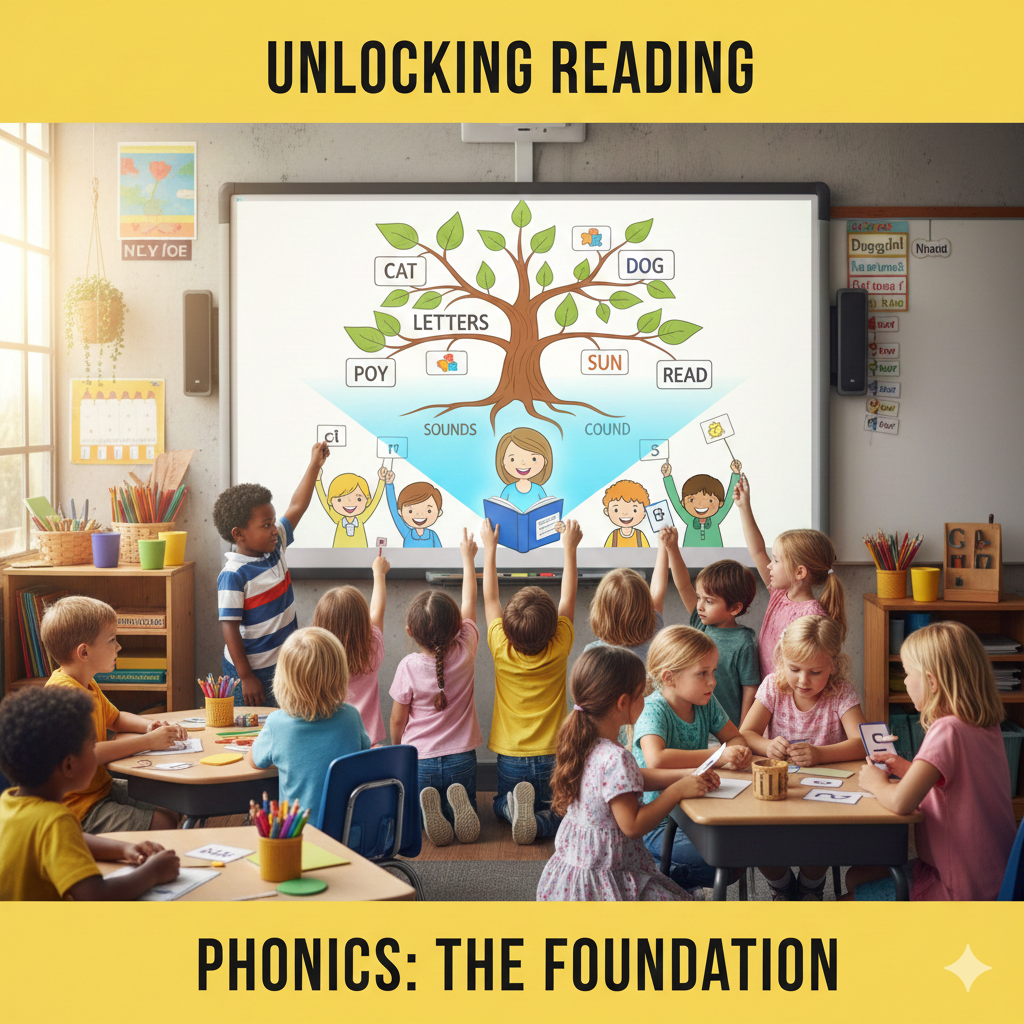
📚 The Unbreakable Code: Reasserting the Primacy of Phonics in Education
The ability to read is the cornerstone of academic success and a fundamental driver of social mobility. At the heart of achieving widespread literacy lies phonics, a systematic instructional method that teaches children to decode the written word by understanding the relationship between sounds (phonemes) and the letters or groups of letters (graphemes) that represent them. The decision by many educational institutions to move away from systematic phonics instruction in the mid-to-late 20th century in favor of approaches like “Whole Language” and “Balanced Literacy” was a detrimental swing of the pedagogical pendulum—a mistake that research has consistently shown to have hindered reading proficiency for a generation of students. Re-embracing explicit, systematic phonics is not a regression but a necessary return to evidence-based practice.
The Indispensable Value of Phonics
Phonics provides children with the essential key to unlock the English language’s alphabetic code. For a young learner, a printed word is merely a collection of unfamiliar shapes. Phonics transforms those shapes into a functional tool by connecting them to the sounds they already use in spoken language. This connection leads to three critical benefits:
- Decoding and Word Recognition: Systematic phonics teaches a child to blend the sounds of individual letters (e.g., /c/, /ă/, /t/) to read a word like “cat.” This gives them a powerful decoding skill that can be applied to almost any unfamiliar word, empowering them to become independent readers. Without this foundational skill, children are often forced to rely on inefficient, short-term strategies like memorizing whole words by sight or guessing based on context or pictures—strategies that break down quickly as texts become more complex.
- Reading Fluency and Comprehension: When a reader can decode words automatically and accurately, they achieve reading fluency. This automaticity is vital because it frees up the brain’s cognitive resources. Instead of struggling to sound out every word, the reader’s working memory can focus entirely on understanding the meaning of the text, directly boosting comprehension. Phonics, therefore, acts as a crucial prerequisite for developing higher-level reading skills.
- Spelling and Encoding: Phonics is a reciprocal skill. Understanding how sounds are represented by letters for reading (decoding) inherently aids in understanding how to represent spoken sounds with letters for writing (encoding or spelling). A solid phonics foundation gives students the tools to segment words into their component sounds and correctly represent those sounds with the appropriate letter patterns.
The Mistaken Shift to Whole Language
The move away from phonics began in earnest in the mid-20th century, culminating with the widespread adoption of the “Whole Language” philosophy, later softened into “Balanced Literacy,” in the 1980s and 1990s. This movement was rooted in the well-intentioned but fundamentally flawed idea that learning to read in a printed environment is a natural process, akin to learning to speak. Proponents argued that explicit phonics drills were tedious and divorced from the joy of literature.
Whole Language and its derivatives encouraged a “top-down” approach where students were immersed in rich texts and encouraged to look at a word holistically, using the context of the sentence, pictures, and the general shape of the word to guess its identity. The flaw, as documented by decades of cognitive science and research—often referred to as the “Science of Reading”—is that reading is not a natural process. Unlike speaking, the brain is not biologically wired to read; it must be taught the explicit steps to connect written symbols to sounds. The guessing strategies taught by Whole Language failed a significant portion of the student population, particularly those from lower socioeconomic backgrounds or those with dyslexia, who require structured, systematic, and explicit instruction to break the code.
The consequence of this educational experiment was a national crisis in reading proficiency. Students who were not taught the alphabetic code explicitly often struggled to transition from reading simple, predictable texts to complex, vocabulary-rich literature. The “reading wars”—the decades-long debate between phonics and whole-word methods—were finally settled by landmark studies, such as those by the National Reading Panel, which confirmed that systematic and explicit phonics instruction is the most effective approach for teaching virtually all children to read.
Conclusion
The education system’s historical deviation from systematic phonics was a costly detour, borne of philosophical preference over empirical evidence. By treating reading as a whole-word guessing game, schools inadvertently denied countless students the necessary tools for genuine literacy. Today, the pendulum is swinging back, and the principles of the Science of Reading are driving a resurgence of systematic, structured, and explicit phostly detour, borne of philosophical preference over empirical evidence. By treating reading as a whole-word gueonics instruction. This return is not about prioritizing mechanical skills over comprehension; it is about recognizing that decoding is the doorway to comprehension. Only by arming every child with the unbreakable code of phonics can schools fulfill their primary mission of creating a generation of confident, fluent, and capable lifelong readers.